

The Miracle of Merino Wool (Yes, I’m Also Shocked)
Merino wool: the fabric I fully expected to mock — until it shocked me into submission. One expensive T-shirt, two sweaty travelers, and zero smell later, I became a reluctant believer. From fast-drying magic to odor-resistant wizardry, this travel-friendly fabric completely changed how I pack, dress, and judge overpriced clothing. If you think merino wool is overhyped, I did too… until I wore it.
The Most Ridiculous Clothing Purchase That Actually Paid Off

I had heard the legends. The whispers. The borderline cult-like devotion to merino wool. According to the internet, it keeps you warm, cool, dry, fresh, comfortable, and possibly makes you a better human.
Naturally, I was deeply skeptical.
I mean, it’s a T-shirt. How life-changing could it possibly be?
Still, curiosity eventually won — and since we had an upcoming cruise and wanted something multi-purpose, practical, and travel-friendly, we decided to give merino wool a try. During Christmas, we boldly asked for… a T-shirt.
Yes. A T-shirt.
And not just any T-shirt — a T-shirt that costs over $100. For us, that’s serious money. So naturally, my husband had all three kids chip in on one shirt. Why financially traumatize one child when you can emotionally burden all three equally?
Christmas morning arrived, and there they were: two merino wool shirts. One for me. One for him. Cue polite gratitude mixed with internal questioning of life choices.
The Science Behind the Sorcery (aka: Why Merino Wool Is Actually Special)
According to reputable outdoor and textile experts, merino wool isn’t your grandmother’s itchy sweater material. High-quality merino fibers are:
Temperature regulating – keeps you warm in cool weather and cool in heat
Moisture-wicking – absorbs sweat and pulls it away from your skin
Breathable – prevents overheating
Odor-resistant – naturally fights bacteria that cause stink
In fact, merino wool fibers can absorb up to 30% of their weight in moisture without feeling wet, while still regulating body temperature. Synthetic fabrics? They trap moisture and odor like a grudge.
Brands like Icebreaker and Smartwool explain that merino’s natural structure allows heat and moisture to escape while still insulating — which basically means it knows what your body needs before you do.
I rolled my eyes.
The Sink Test: Shock #1
I decided to test the legendary fast-dry claim. I washed my shirt in the sink, wrung it out, and draped it over the tub overnight.
By morning?
Dry. Completely dry.
Already impressed. Mildly suspicious.
Mexico: The Real Test Begins
Fast forward to March and our trip to Mexico. I wore my merino shirt on the plane — comfortable, breathable, and not weirdly clingy, which is always a plus.
Then I left it hanging in the room until we went on a hot, sunny excursion. I wore it again. It was hot. Like, question-your-life-choices hot. The shirt was charcoal grey, which normally equals instant regret.
But… I wasn’t overheated.
Friends commented that I must be roasting in a dark shirt, but honestly? I felt about the same as if I were wearing something lightweight and summery. So yes, Point #2 confirmed: it keeps you cool in heat.
And — brace yourselves — after wearing it two days in a row… it did not smell.
Which brings us to the real miracle.
My Husband: The Ultimate Stress Test
Now, I love my husband dearly. But let’s just say he is not naturally blessed with long-lasting freshness, especially in heat.
On a scorching day, he wore his merino shirt on a full-day excursion to Chichén Itzá. This involved sun, sweat, walking, heat, and questionable hydration choices.
Later in the week, while packing to fly home, everything he had worn smelled… honest. Very honest.
Airport + plane + several hours + questionable shirt freshness = cruel and unusual punishment for fellow travelers.
So I cautiously sniff-tested his merino shirt from Chichén Itzá.
Nothing.
No odor. No funk. No hint of sweat.
I literally questioned whether he had actually worn it.
He wore it on the plane, and for the first time in history, I did not complain once about suspicious smells. A miracle.
The next day while unpacking, I sniff-tested both our shirts again. Still fresh.
Total shock. Total game changer.

So… Is Merino Wool Worth It?
Look — I went into this experience fully prepared to mock it.
But now?
I get it.
One T-shirt (okay, two) turned me into a believer. Merino wool actually delivers on the hype:
Doesn’t stink
Dries insanely fast
Comfortable in heat
Great for travel
Reduces laundry needs
Somehow survives multiple wears without becoming socially unacceptable
The only downside?
💸 That price tag still hurts my soul.
But considering I can wear it multiple days in a row, pack fewer clothes, and not offend strangers on airplanes — I’m starting to think it might actually be… worth it.
And I hate that.

The Reality of Downsizing: What They Don't Tell You About Moving to a Smaller Home
The Freedom of Less: Why Downsizing Might Be Your Best Retirement Decision
Before we retired, we made a decision that would shape everything that followed—we downsized to a bungalow. The house that had been perfect for raising our family now felt like too much—too many rooms to clean, too many stairs to climb, too much yard to maintain.
The decision wasn't easy. That house held every milestone, every memory we'd made as a family. But we realized it had become more burden than blessing, and if we were going to enjoy retirement, we needed to make the move while we still had the energy for it.
Six months into our new bungalow, I can honestly say: this was one of the smartest decisions we ever made. Our monthly expenses dropped significantly, and we've discovered that freedom doesn't come from square footage—it comes from having exactly what you need and nothing you don't.
If you're considering downsizing before retirement, you're not alone. You're making space for what comes next...
We planned it for years. Once the kids were gone and we retired, we'd downsize. Simple, right? We'd be those zen minimalists sipping wine in our clutter-free haven, congratulating ourselves on our brilliant life choices.
Well, three years into our "smaller" home, I'm here to tell you the truth about downsizing—and it's messier, funnier, and way more complicated than those smug lifestyle blogs admit. Spoiler alert: I'm typing this while staring at unpacked boxes from 2021..

The House We Left Behind
Our family home wasn't a mansion by any stretch. Just under 2,400 square feet with five bedrooms (okay, four real bedrooms and one small room we generously called an office). Two ensuite bathrooms, a main bathroom, and a powder room on the main floor. During COVID, that little office became my fortress of solitude—a place where I could close the door and everyone knew "Mom's working, don't bother her unless someone's bleeding."
My kids were angels about respecting that boundary. Probably because they were terrified of me on conference calls.
But here's what we didn't have for 16 years: a basement bathroom.
Yes, you read that right. We finally installed one just as we were preparing to sell. It was beautiful. I barely got to use it. Such is life.
The Never-Ending Renovation Cycle (AKA My Personal Hell)
We bought our house when it was only two years old. "Oh, you're so lucky!" people would gush. "A new house—nothing to do!"
Laughs in perpetual renovation
Here's my superpower: I have an uncanny ability to buy houses from older women whose decorating tastes peaked somewhere between the Y2K panic and the first iPhone. This means even a "new" house comes pre-vintage. We spent 16 years updating that place, one exhausting, expensive project at a time.
The grand finale? Just before listing the house, we had to:
Rip up the entire kitchen floor (nothing says "fun" like shattered tile at 7 AM)
Move all our cabinets into the living room (ever tried cooking dinner with your kitchen in three rooms? Don't.)
Retile everything while living in chaos
Paint the cabinets (finally, goodbye golden oak!)
Install new stone countertops
Oh, and install that mythical basement bathroom I mentioned
The irony? The house finally looked exactly the way I'd always dreamed—right when we handed the keys to someone else. They probably repainted everything beige within a month.
Buying High, Selling High, and Learning Nothing Apparently
We bought and sold during that insane market when prices were stratospheric but just starting their descent. Yes, we overpaid. Massively. But we also sold high, so it balanced out... kind of... if you don't think about it too hard.
And guess what brilliant move we made next? We bought another new house from another older woman. Her taste? Frozen solid in 1999. I'm talking light oak cabinets - again, and laminate countertops that probably remember Seinfeld's final episode.
Those kitchen cabinets are screaming for paint. Nearly four years in, they're still waiting, sporting their original honey oak finish like a time capsule nobody asked for. But when you're juggling a fence installation, a basement finish, and a new patio, there's only so much time and money to go around.
The cabinets can wait. They've already waited 25 years. What's a few more months? (This is what I tell myself at 2 AM when I can't sleep because those cabinets are haunting me.)
The Three Stages of Purging (And Why You'll Never Actually Finish)
Downsizing means getting rid of stuff. Mountains of stuff. Everests of stuff you forgot you owned. We went through three distinct purge phases:
Phase One: Pre-listing Panic
The frantic scramble to declutter before strangers judge your life choices. Donation bags multiplied like rabbits. I threw out things I'd sworn were "sentimental" just days before.
Phase Two: Moving Day Reckoning
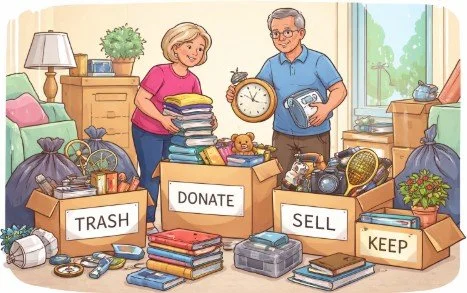
The brutal "WHY DO WE STILL HAVE THIS?" fights with your spouse while knee-deep in packing tape and bubble wrap. More bags to charity. Still somehow ended up with 47 boxes labeled "miscellaneous."
Phase Three: The Eternal Unpacking
Over three years later, we're still opening boxes and experiencing a mix of confusion and horror. "We packed twelve serving platters? For what occasion—the Second Coming?" There are still plenty to go through. I'm convinced those boxes are secretly reproducing in the storage room when we're not looking.
The Plot Twist: Two Houses (Because We're Gluttons for Punishment)
Part of our master plan involved building a summer house on the east coast where I'm from. Because clearly, what we needed while downsizing one house was to manage two properties simultaneously. Genius move, really.
This "simplified" our downsizing strategy in absolutely zero ways:
Shipping "extra" and older furniture to the summer house (translation: the stuff too ugly for the new main house but too guilt-inducing to donate)
Buying new pieces for the main house (there goes the downsizing budget)
Playing a never-ending game of "Which House Does This Belong In?"
Having the slow, dawning realization that we hadn't downsized—we'd just distributed our clutter across two postal codes
Brilliant. Just brilliant.
The Time Crunch No One Warns You About (Thanks for Nothing, HGTV)
Here's what those glossy downsizing blogs conveniently forget to mention: going back to work changes everything. When we planned this downsizing adventure, we envisioned leisurely Saturday mornings organizing closets, thoughtfully curating our belongings while sipping artisanal coffee and discussing which throw pillows spark joy.
Reality? Work resumed. Life got busy. Weekends disappeared into errands and exhaustion. Those boxes? Still sitting there, judging me every time I walk past. The house projects? Happening at the speed of continental drift.
Turns out Marie Kondo doesn't make house calls, and nobody warned me that downsizing with a full-time job is basically a part-time job you're not getting paid for.
Practical Tips They Don't Put in the Pinterest Guides
Alright, enough therapy. Here's what actually helps when you're drowning in boxes and outdated cabinetry:
1. The One-Year Rule is a Lie
You know that advice: "If you haven't used it in a year, donate it"? Adorable. Here's the truth: you'll open a box three years later, find your grandmother's casserole dish, and cry because you thought you'd donated it. Give yourself permission to keep some stuff "just because." We're downsizing, not entering a monastery.
2. Take Before Photos (For Your Sanity)
Document your old house before you renovate it to perfection and then leave. Why? Because in your new place, when you're staring at those 1999 cabinets at 11 PM, you can look back and remember: "Oh right, we survived worse." It's oddly comforting.
3. The Box Labeling System Everyone Ignores
Label boxes by room AND by priority. "Kitchen—Daily Use" vs. "Kitchen—Serve-ware for That Dinner Party We'll Never Host." Three years later, you'll know exactly which boxes can stay sealed forever. (It's the second category. It's always the second category.)
4. Budget 50% More Than You Think
Whatever you think renovations will cost, multiply by 1.5. Minimum. Those kitchen cabinets you thought you'd paint for $200? Try $800 once you factor in primer, good paint, hardware, your time, and the inevitable second coat because the first one looked "blotchy."
5. Make Friends with Your Local Donation Center
You'll be there weekly. Monthly if you're lazy like me. The workers will know your name. Embrace it. You're keeping someone employed with your clutter.
6. Don't Renovate Everything Before You Sell
This one hurts, but it's true. We installed that beautiful basement bathroom right before we left. The new owners probably think we're idiots (they're right). Save the big projects for YOUR house, not the next person's.
7. Give Yourself Five Years, Not Two
Everyone says downsizing takes two years to "settle in." They're lying. Give yourself five. Maybe seven. The boxes will still be there. The cabinets will still need painting. That's just life now.
8. The Storage Unit is Not a Solution
It's a very expensive way to avoid making decisions. If you're paying monthly to store things you haven't thought about in a year, just donate them. Rip the bandaid off. Your bank account will thank you.
9. One Project at a Time (Even If It Kills You)
Trying to do the fence, the basement, AND the patio simultaneously will end in tears and marital strife. Pick one. Finish it. Then start the next. Revolutionary concept, I know.
10. Lower Your Standards (Just a Little)
That Instagram-perfect home? Not happening while you're working full-time and still unpacking. And that's okay. A lived-in house beats a perfect house every single time. Those honey oak cabinets can wait another six months. Or a year. Who's counting?
What I've Learned So Far (Besides Humility)
Three-plus years into downsizing, here's my brutally honest takeaway:
Downsizing isn't a one-time event—it's a lifestyle you didn't ask for
Your timeline will expand—double it, then add six months for good measure
Renovations follow you—like a really persistent ex, they never truly leave
Perfect timing doesn't exist—we still haven't painted those damn cabinets
It's worth it anyway—even imperfect, incomplete, and slightly chaotic
Our house isn't magazine-ready. We're still opening boxes marked "2021" (I'm afraid to know what's in them). The kitchen cabinets are still sporting their Y2K aesthetic. There's a fence that needs staining, a basement that's half-finished, and approximately 47 throw pillows that I swear I purged but somehow reappeared.
But you know what? We're building our life here, one unfinished project at a time, one mysterious box at a time, one "we'll get to it eventually" at a time.
And someday—probably right before we sell again and move into an even smaller place with even more outdated fixtures—those cabinets will finally get painted.
I'm giving it another two years. Maybe three. Definitely by 2030.


"Still Got It" - over 50 work comeback
There’s a strange myth that lingers around work and age—that opportunity has an expiration date. That once you reach a certain point, the door quietly closes and you’re expected to be grateful for whatever’s left. But lived experience tells a very different story. Starting new job opportunities later in life isn’t about proving anything; it’s about finally knowing what you bring to the table.
Older workers carry something no résumé bullet point can fully capture: judgment shaped by experience, calm under pressure, and the confidence to solve problems without drama. We’ve learned what matters, what doesn’t, and how to work with people—not just processes. In a world obsessed with speed, there is real value in steadiness, perspective, and the ability to see the bigger picture. This isn’t the end of the road professionally—it’s a recalibration, and for many of us, a surprisingly powerful one.

Still Got It
Because "Retired" Doesn't Mean "Retired from Being Awesome"
Let's get one thing straight: Retirement? Sure, I did that. Being done? Hell no. I've got over 35 years of experience in public and human services, and spoiler alert—I still have a LOT to give to the workplace. Not because I need the validation (been there, done that, got the t-shirt), but because experience is the superpower nobody wants to admit they're desperate for.
The Superpowers Nobody Talks About
1. We Read People Like Yesterday's News
After decades in the workforce, you develop this magical ability to spot personalities from a mile away. You know who'll actually show up and do the work versus who'll happily let you carry the load while they collect the credit. You can identify the ego-driven players versus the genuine hearts. And here's the kicker—I've learned to work with ALL of them.
Years ago, would I have stroked someone's fragile ego just to get a project done? Absolutely not. Maybe I needed mine stroked too—who knows. But now? If ego-stroking is what moves the needle, hand me the metaphorical brush. I'll paint that ego Sistine Chapel-level beautiful if it means the work gets done. That's not selling out; that's strategic brilliance.
2. We've Seen This Movie Before
Change management? Please. We've navigated more transitions than a GPS on a road trip. When I point out pitfalls, people think I'm being resistant to change. I can literally HEAR the eyeballs rolling. But guess what happens six months later? Exactly what I said would happen.
It's not because I'm the smartest person in the room—not by a long shot. It's because I've lived through it before. The new vocabulary might be different, but the problems? Same old tune, just a different remix.
The Government Transformation Paradox
Let me tell you about my favorite workplace comedy: government "transformation." Governments LOVE this word. They live for it. But here's the thing—with administration cycles lasting 4-8 years, they're basically professional wheel-reinventors.
They genuinely believe something is "new" and "groundbreaking." In reality? We did this in 1997, called it something else, and it didn't work then either. True transformation requires RISK. But public service? Risk-averse doesn't even begin to cover it. There's only so much risk that's tolerable, so what you get is calculated reinvention of previous ways of doing things.
Maybe this happens in other industries too, but in public service, it's practically an art form. And here's the kicker—North Americans think we're this "new world" open to fresh ideas, but mostly we just copy what European countries did twenty years ago. Because guess what? Older countries have that experience too.

Government professional at work
What We Bring to the Table (Besides Sass)
Institutional Memory: We remember why certain decisions were made and what happened last time someone tried that "innovative" approach.
Emotional Intelligence: We've made all the interpersonal mistakes already, so you don't have to.
Perspective: We know what's actually an emergency and what just feels like one because someone's PowerPoint deadline is looming.
Mentorship: We can actually explain the "why" behind processes, not just the "what."
Crisis Management: Nothing phases us anymore. Your "crisis" is our Tuesday.
Network Gold: Decades of professional relationships mean we know who to call to actually get things done.
“There are real advantages to hiring these employees. Studies have shown that older workers may lower time-keeping and absentee issues; they also tend to have higher levels of commitment to their jobs and loyalty to their employers…”
— Richard Branson
Hot Side Gig & Remote Work Ideas for the Over-50 Crowd
🎯 Consultant
Use your decades of experience to advise companies. They'll pay you what they should've been paying you all along.
✍️ Freelance Writer
Industry blogs, white papers, grant writing—someone needs your knowledge in words.
🎓 Online Instructor
Teach courses on platforms like Udemy, Coursera, or specialized training sites.
🤝 Executive Coach
Help younger leaders navigate the minefields you've already crossed.
📊 Project Manager
Remote PM roles are everywhere, and experience actually matters here.
💼 Virtual Assistant
High-level VA work for executives—scheduling, research, problem-solving.
📝 Grant Writer
Non-profits will love you forever. Great remote work with flexible hours.
🎤 Public Speaker
Virtual conferences need experts. You've got stories that need telling.
🔍 Evaluation Specialist
Companies need people who can assess programs and processes. Hello, that's us.
🌐 Nonprofit Board Member
Often paid positions, always influential, completely aligned with your values.
“Age is about as totally unrelated to job performance as any measure can be.”
— Schmidt and Hunter
“Older workers bring decades of experience and unique skills that can only be developed over many years.”
— Eileen Suazo

Resources to Get Your Comeback Started
Job Boards & Remote Work Sites
American-Specific Job Boards
FlexJobs (flexjobs.com)
Vetted remote, part-time, and flexible jobs. Worth the subscription.
RetiredBrains (retiredbrains.com)
Specifically for people over 50 looking for work. Finally, someone gets it.
Workforce50 (workforce50.com)
Job board focused on experienced professionals. No ageism here.
AARP Job Board (aarpworksearch.org)
Free resource with thousands of listings from age-friendly employers.
We Work Remotely (weworkremotely.com)
Massive remote job board across all industries.
Remote.co (remote.co)
Remote jobs plus articles on working from home successfully.
Canadian-Specific Job Boards
Job Bank (jobbank.gc.ca)
Government of Canada's official job site. Free and reliable.
Canada's Top 100 Employers - Over 40 (canadastop100.com/older_workers)
Annual list of Canadian employers with age-friendly policies. Research before you apply.
Workhoppers (workhoppers.com)
Canadian platform connecting experienced workers with flexible opportunities.
CanadaJobs (canadajobs.com)
Major Canadian job board with resources for mature workers.
Indeed Canada (ca.indeed.com)
Search "older worker" or "mature worker" for age-friendly postings.
Eluta (eluta.ca)
Canadian job site pulling directly from employer websites. Interface is ugly, but it works.
NoDesk (nodesk.co/remote-jobs/canada)
Curated remote Canadian jobs across all industries.
Working Nomads (workingnomads.com/remote-canada-jobs)
Remote jobs in Canada with email alerts. No nonsense.
Remotive (remotive.com/remote-canada-jobs)
Quality remote Canadian jobs, screened and curated.
Provincial Resources
ALIS - Alberta (alis.alberta.ca/tools-and-resources/resources-for-mature-workers)
Alberta's resource hub for workers over 45. Career planning tools and labour market stats.
The Working Centre - Ontario (theworkingcentre.org/workers-over-45)
Waterloo region support for workers 45+. Worth checking if you're in Ontario.
Targeted Initiative for Older Workers (TIOW) (canada.ca - search TIOW)
Federal program for unemployed workers 55-64. Check your provincial ministry for local projects.
Freelance & Consulting Platforms
American Freelance & Consulting Platforms
Upwork (upwork.com)
Massive freelance marketplace. Your experience will stand out here.
Catalant (gocatalant.com)
High-end consulting projects with major corporations.
Toptal (toptal.com)
Elite freelance network—selective but well-paid.
Business Talent Group (businesstalentgroup.com)
Connects experienced professionals with consulting opportunities.
Canadian Freelance & Consulting Platforms
Freel (freel.ca)
Exclusively for Canadian freelancers. Local gigs, Canadian clients. 700+ professionals already here.
Freelance.ca (freelance.ca)
Canadian platform connecting local talent with businesses. Browse projects or get contacted directly.
Workhoppers (workhoppers.com)
Canadian-based platform with AI matching. No commissions or recruiting fees. Pay by hour or project.
Canadian Virtual Gurus (canadianvirtualgurus.ca)
Alberta-based. All freelancers are Canadian. Virtual assistant and specialized services.
RPSAV (rpsav.ca)
Réseau des professionnelles en soutien administratif virtuel. French-speaking freelance assistants and secretaries.
Flexable (flexable.work)
Growing Canadian presence. Curated onboarding process. Focus on higher-value, long-term contracts.
LinkedIn Services Marketplace (linkedin.com)
Leverage your professional network. List services on your profile. Clients come to you. No platform fees.
Learning & Skill Development
LinkedIn Learning (linkedin.com/learning)
Brush up on skills or learn new ones. They'll never know you learned it last Tuesday.
Coursera (coursera.org)
University-level courses, many free. Because we're never too old to learn.
SCORE (score.org)
Free mentoring and resources if you're thinking about starting your own business.
Networking & Community
LinkedIn (linkedin.com)
Update that profile. Connect with old colleagues. You know more people than you think.
Reenergize (reenergizeyourcareer.com)
Community and resources for professionals over 50.
Wahve (wahve.com)
Connects experienced insurance and accounting professionals with remote wor
Canadian Learning Platforms & Institutions
Athabasca University (athabascau.ca)
Canada's open university. 850+ online courses. Self-paced learning. Actual degrees and certificates.
University of Toronto - Coursera (coursera.org)
Free courses from U of T. Get certificates. Looks good on LinkedIn.
UBC Extended Learning (extendedlearning.ubc.ca)
Professional development, certificates, micro-credentials. British Columbia's top university.
BCIT Free Online Learning (bcit.ca/free-online-learning)
British Columbia Institute of Technology offers free short courses (6-14 hours). Career exploration, skills upgrading.
eCampusOntario (ecampusontario.ca)
Access to 200+ online courses from Ontario colleges. Many free options.
Centennial College Online (centennialcollege.ca/programs-courses/online-learning)
200+ online courses. Certificates, diplomas, graduate studies. Ontario-based.
Robertson College (robertsoncollege.com)
40+ online courses. Micro-courses (10 hours) to full diplomas (51 weeks). Flexible, industry-led.
Canada School of Public Service (csps-efpc.gc.ca)
For federal public servants but also has free courses open to all Canadians. Leadership, skills development.
Class Central (classcentral.com/country/canada)
Aggregator of free Canadian university courses. U of T, UBC, and more.
Government-Funded Training Programs for Older Workers
Better Jobs Ontario (ontario.ca/betterojobs)
For laid-off workers. Pays for training AND living expenses while you retrain. Open to all ages.
Ontario Job Creation Partnerships (ontario.ca)
For EI recipients. Develop employable skills, get work experience. Increases your chances of long-term employment.
Skills Training for Employment - Older Workers 55+ (B.C.)
Contact your local college or employment centre. B.C. invested $5 million annually for 733+ older workers. Provincial programs like "Encore Careers" at Douglas College.
Ontario Get SET Program (ontario.ca)
Improve reading, writing, math, computer skills. Free. Service provider creates personalized learning plan.
Canada-Alberta Job Grant (alberta.ca)
Employers can get funding to train you. Worth knowing about when negotiating with potential employers.
Your Provincial Employment Centre
Every province has employment services for older workers. Skills assessments, resume help, training referrals. Search "[your province] employment services older workers."
ALIS - Alberta Learning Information Service (alis.alberta.ca/tools-and-resources/resources-for-mature-workers)
Career planning tools, labour market info, resources for workers 45+. Alberta-specific but valuable even if you're elsewhere.
"They say experience is wasted on the old. I say opportunity is wasted on the young who don't know what they don't know."
The Bottom Line
We're not looking for handouts or sympathy hires. We're looking for organizations smart enough to recognize that experience isn't a liability—it's the competitive advantage they've been missing.
So yeah, I'm "retired." I'm also available, capable, and carrying around 35+ years of wisdom that no amount of fresh graduate enthusiasm can replicate. The workplace needs what we've got, even if they don't know it yet.
Now, if you'll excuse me, I have some ego-stroking to do and a transformation initiative to politely predict the failure of. Again.

Planning Our First Mediterranean Cruise
Planning your first Mediterranean cruise is equal parts excitement and mild logistical panic. One minute you’re dreaming of coastal sunsets and fresh pasta, the next you’re trying to figure out how you’re supposed to see Rome, Florence, and Barcelona without sprinting through them. The key is balance—between sea days and port days, ambition and reality, planning and leaving room for wandering. Your first Mediterranean cruise won’t let you see everything, but with the right mindset (and very comfortable shoes), it can be the perfect introduction to Europe by sea.

There’s something deliciously ironic about planning a first anything at this stage of life. We’re seasoned now—well marinated in responsibility, careers, carpools, and college tuition—but there’s still plenty of youth left in the curiosity department. Enough, at least, to look at a map of the Mediterranean and think: Yes. That. Let’s finally do that.
This trip is our bucket-list celebration: a milestone birthday, a meaningful anniversary, and a long-imagined Mediterranean cruise—11 days at sea, bookended by time on land. Three days in Barcelona before the cruise to ease into the rhythm, and three days in Italy afterward to linger, wander, and decompress before heading home.
But dreaming is only half the fun. The other half? Research. Planning. Thinking ahead so the trip feels joyful, not rushed.
Here’s what I’m learning as we plan.
Why a Mediterranean Cruise (and Why Now)
A Mediterranean cruise is ideal for a “seasoned with youth” traveler. You unpack once, visit multiple countries, and still have the comfort of returning to the same cabin every night. For a first cruise, it’s especially appealing—structured but not rigid, adventurous without being exhausting. Well, it maybe exhausting as we want to see everything there is to see.
The Mediterranean also offers incredible variety: ancient history, coastal villages, world-class food, and landscapes that feel both cinematic and deeply human. It’s not one experience—it’s many.
And celebrating a big birthday and anniversary? That deserves something expansive.
Timing Is Everything: Booking 18 Months Ahead
Booking this far ahead gives us the luxury of time—time to research each port, figure out what’s actually worth seeing, and avoid the classic mistake of trying to “do Europe” in six hours and a panic. This isn’t a trip we take every other weekend, so we want to squeeze every possible ounce of value out of it. Booking early also comes with excursion credits, and you can be sure we intend to use every last one. Free money is still money.
Mostly, we want to explore at our own pace, on our own terms—without being herded around with a paddle and a flag. That said, we are very committed to making it back to the ship on time. Romantic sunsets are great. Missing the ship? Less so.
After far too much research (and a few late-night “just one more article” moments), one thing became very clear: booking 12–18 months in advance is often the sweet spot for popular itineraries like the Mediterranean.
Why?
You get first dibs on cabins—and yes, location matters more than I ever expected
Early-booking perks like onboard credit (aka justification for nicer wine)
Plenty of time to stalk airfare and hotel prices without breaking into a sweat
Far less stress—planning becomes part of the fun instead of a full-blown crisis
Cruise prices generally rise as ships fill, and while last-minute deals do exist, they’re a gamble—especially for milestone trips tied to specific dates. This is not the vacation to leave to fate, luck, or a flash sale at 2 a.m. Some trips deserve a plan.
Choosing the Right Itinerary (Not Just the Ship)
It’s very easy to fall in love with the ship—and yes, the amenities are lovely—but the itinerary is what really runs the show. A floating hotel is nice. Knowing where it’s actually taking you? That’s the point.
Things we’re paying close attention to:
Port balance:
Too many sea days can feel endless; too many ports and suddenly you’re speed-walking Europe with a map and mild panic. Let’s be honest—we want to see everything, so there will be some speed walking. Comfortable shoes aren’t a suggestion; they’re a survival tool.Port depth:
Longer port stays mean less “wave at the city from the bus window” tourism. Not all ports are close to the places you actually want to see. Trains, regional rail, and early morning alarms quickly become the norm—and once you accept that, it actually adds to the adventure.Embarkation and disembarkation cities:
These quietly shape your trip more than you might expect. Do you want to spend time exploring before boarding, or are you ready to jump straight into cruise mode? The same question applies at the end—rush to the airport or squeeze in one last coffee, walk, and moment of denial before heading home.Transit reality check:
Mediterranean ports often involve real logistics: tenders, traffic, train schedules, and the occasional “are we sure this is the right platform?” moment. Build in buffer time. Missing one attraction is far better than missing the ship.Energy budgeting:
Back-to-back port days look amazing when you’re planning. In real life, they can lead to museum overload and sitting in cafés purely to recover. Choose your must-sees, leave room to wander, and remember—sometimes the best part of the cruise is doing absolutely nothing on board.
We’re also looking beyond this trip. Once you start researching cruises, you realize they’re not just vacations—they’re gateways. This first one may very well set the tone for how (and where) we travel next.
We embark in Barcelona and disembark in Trieste, which means three days on either side of the cruise. That gives us time to properly explore Barcelona—its neighborhoods, its food, and its general joy of life—and then Venice and Rome, which feels like a once-in-a-lifetime experience I’m already counting down to. I booked this cruise a year ago, and now it’s officially time to make sure we actually see what we want to see.
Then came hotels. And let’s be honest: hotel options range from “should I keep my shoes on?” to ultra-luxury where the pillows probably have a backstory. But how much time do I really want to spend in a hotel room? I just want it clean, safe, and close enough that I don’t need a spreadsheet to get around.
So we started by researching neighborhoods—because location matters more than thread count. Once we narrowed that down, we looked at hotels and landed on solid mid-range options: comfortable, well-located, and not requiring a second mortgage. Doing the research ourselves saved money, gave us better choices, and let us spend where it actually counts—on experiences, food, and getting lost on purpose.
Pre-Cruise: Three Days in Barcelona to Adjust and Absorb
Arriving three days before the cruise isn’t indulgent—it’s smart.
It allows time to:
Adjust to jet lag
Explore without a clock
Protect against travel delays
Start the trip grounded, not groggy
Make sure we are there in plenty of time to get to the ship
Hotel research matters here. We’re prioritizing:
Location: Walkable neighborhoods near key attractions or cruise ports
Feedback: Consistent reviews over flashy photos
Price vs. value: Comfort and convenience beat luxury at this stage
Being close to public transit or major landmarks saves energy—and energy is currency when you want to enjoy every moment.
Post-Cruise: One day in Venice and 2 in Rome (to absorb culture)
After 11 days of movement, schedules, and stimulation, ending the trip with three days in Italy feels very intentional. Rome is an invitation to linger, to breathe, to sit down and actually be in the city instead of racing through it like it’s a scavenger hunt.
Here’s what we’re looking for:
A well-located hotel (again—location is everything)
Space to wander without an agenda
Cafés, piazzas, and unplanned afternoons
Pasta and gelato (obviously)
Rome isn’t a checklist city. It’s a sit-down-and-look-around city. Ending the journey here gives the experience room to settle, allows the sights to sink in, and gives us a moment to celebrate having survived the past 11 days of organized chaos. Honestly, it’s also a perfect excuse to practice our “I’m pretending to know Italian” smiles while eating gelato for breakfast.


Research, Reviews, and the Very Serious Bathroom Plan
We used booking sites to look for hotels, but let’s be clear—photos mean nothing without reviews. I want to hear from real people who stayed there, walked the neighborhood, and survived the experience. Recent reviews are especially important. A hotel can look charming online and still be located somewhere that feels a little too adventurous after sunset. Reviews saved us time, money, and potential regret.
My husband does his research a different way—YouTube. Lots of YouTube. And as much as I hate to admit it, it’s incredibly useful. We’ve found a few favorite travel influencers who actually walk through neighborhoods, explain transportation, and show what things really look like without strategic camera angles. Try it. You might fall down the rabbit hole too—and come out oddly prepared.
Thanks to this deep dive, we’ve picked up some excellent tips. For example, using an eSIM in Europe so we can have data without selling a kidney to our phone provider. We’ve also started pinning locations on maps ahead of time—restaurants, landmarks, cafés—so we don’t end up standing in the middle of a plaza debating options while everyone else looks like they know exactly where they’re going.
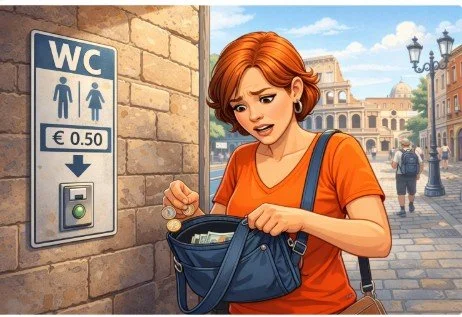
And then there’s my contribution to the planning process. Being a woman over 50, I’ve asked him to pin public bathrooms—and yes, note whether they cost money. I do not want to be taken short in Europe, nor do I want to discover at a critical moment that I need exact change. This is not the kind of surprise I enjoy while traveling. Some people plan for museums. I plan for bladder management. It’s called experience. Priorities, people—priorities.
What I’m Thinking About (That I Didn’t Before)
Planning this trip has reminded me how travel priorities evolve—or maybe it’s just that over-50 brains work differently.
Comfort matters—but so does curiosity. You can’t fully appreciate a new city if your feet are staging a rebellion. Slower can be richer than faster. Those two extra hours wandering a piazza? Priceless. Paying a little more for location can save a lot of energy. Experiences matter more than souvenirs (though gelato is always an exception). And perhaps most importantly: anticipation is part of the gift. Researching, planning, imagining—it’s all a form of travel before the travel.
Ship Life
The ship itself is practically a floating city—and yes, it’s geared toward seniors, or at least that’s the reputation. We’ve booked the drink and specialty dining packages because a vacation without at least one glass of wine in hand feels irresponsible. Onboard, we’re thinking about what to enjoy: spa treatments, the quiet lounges, maybe a game of shuffleboard (or at least people-watching). Sea days are for lingering, reading, napping, and sampling the restaurants without the guilt of missing ports. Booking dining in advance ensures we get our preferred times and avoid the “hangry at sea” scenario.
Excursions and Ports
Then there’s the fun but slightly overwhelming part: planning what to see in each port. Excursion research has become a full-time hobby. Which sites matter most? How much walking is too much? Which small cafés and gelaterias are worth the detour? And timing is everything—if we miscalculate, we risk missing the ship, and I refuse to live through that kind of midlife panic.
Balancing structured excursions with wandering on our own gives us the best of both worlds. We’ve also started pinning everything on maps: sights, restaurants, bathrooms (always bathrooms), and hidden corners that only locals know. This way, each stop has flexibility without becoming chaotic.

Consideration: What to Wear in Europe
Ah, the eternal question: what does one actually wear for three weeks in Europe in September without turning into a walking laundry basket? This isn’t just fashion—it’s logistics, strategy, and survival.
We’re talking 3 weeks out of a suitcase, multiple cities, cruise life, and city exploration. Layers? Absolutely. Comfy walking shoes? Mandatory. A little flair for photos? Obviously. And don’t even get me started on deciding whether to pack for summer, fall, or “who knows, let’s just hope for sunny days.”
Enter the modern miracle: cruise laundry service. Wow. These ships think of everything. My plan: use laundry service the first few days on board, somewhere mid-cruise, and again just before disembarking. This should drastically reduce the amount of dirty laundry I lug home—and hopefully jet lag won’t involve a mountain of socks and underwear waiting for me.
Then there’s my husband’s YouTube friends’ latest advice: merino wool. Yes, apparently you can wear it for days on end without cleaning it. Not sure I’m brave enough to test that after hours of walking through cobblestone streets, but I’m willing to try it… cautiously. The selling point? It’s easy to wash, which I suspect will be my preferred method.
We each bought one merino item for Christmas so we can experiment before committing (and breaking the bank). I’m a little skeptical, but hey—this is part of the fun: testing, planning, and occasionally looking ridiculous in the name of comfort.
Packing for Europe at our age is part art, part science, and part negotiation with your suitcase. But thanks to a little strategy, a dash of curiosity, and a hint of merino wool, I think we can survive—and maybe even look cute doing it.
Looking Ahead
We still have eight months before this cruise, and plenty of planning ahead of us. This is my first cruise, which means I could either fall head-over-heels for the cruise life—or politely retire it in favour of other adventures that don’t involve putting my luggage in a tiny closet. Either way, it’s part of the fun: imagining, planning, and debating whether a shuffleboard tournament counts as a “must-do activity.”
This Mediterranean cruise isn’t just a celebration of years lived—it’s an investment in years to come. Proof that even with experience behind us, there’s still so much ahead worth discovering. New cities, new food, new gelato flavors, new people to laugh with, and yes, maybe even new ways to navigate Europe without losing coins for the bathroom.
Seasoned, yes. But still hungry for what’s next. And honestly? That might be the best part. The thrill isn’t just in being somewhere new—it’s in knowing that, after all these years, curiosity still wins over comfort (most of the time).
Eight months may seem like a long countdown, but it’s actually just the perfect amount of time to dream, research, plan, and overthink… and then finally go and live it.

Makeup Tips for Mature Skin: Because We're Not Trying to Look 25
Makeup tips for Mature skin
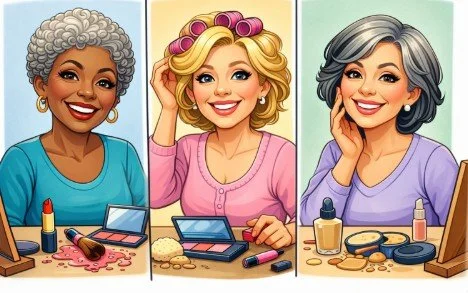
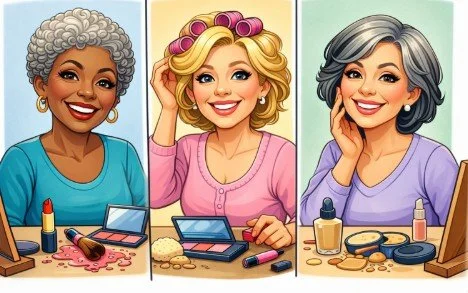
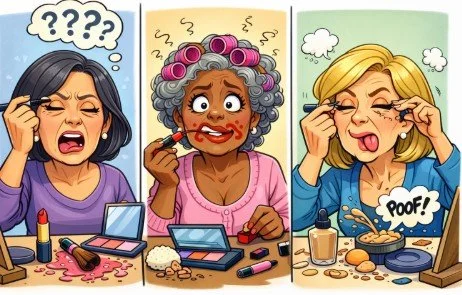
There’s a special kind of bravery that comes with putting on makeup after 50. Your eyes water for no reason, your hands don’t quite listen anymore, and suddenly eyeliner feels like an extreme sport. Some days end with mascara on your cheekbones and foundation settling into places you didn’t know existed. And then there are the good days—the ones where you finish, step back, and think, Well hello… there I am. This is the reality of makeup in midlife: a little chaos, a lot of humor, and moments of confidence that feel hard-won and well deserved.
A brutally honest guide from someone who peaked at mascara application in 1987
Look, I'm going to level with you right from the jump: I have absolutely no business writing a makeup guide. None. Zero. I am the human equivalent of a "Pinterest Fail" meme when it comes to cosmetics.
But here's the thing—I'm pretty sure there are thousands of us out here, wandering through Sephora like confused tourists in a foreign country, pretending we understand what "setting spray" is and nodding knowingly when the 19-year-old sales associate mentions "baking." (Spoiler alert: she's not talking about cookies, and I'm still disappointed about it.)
Full disclosure: My makeup skills peaked somewhere around 1987 when I mastered the art of applying Maybelline Great Lash mascara without poking myself in the eye. It's been downhill ever since.
The Problem With Modern Makeup (Or: Why Is Everything So Complicated Now?)
Remember when makeup was simple? You had foundation (one shade: "sort of beige"), lipstick (red or pink), and if you were feeling fancy, some blue eyeshadow. Done. You looked like every other woman in America, and that was fine.
Now? NOW we have primers and color correctors and highlighters and bronzers and contour kits and "strobing" and about 47 other things I can't even pronounce. When did makeup application become a full-time job requiring a degree in fine arts?
And can we talk about how our skin has completely betrayed us? You try to apply a little eyeshadow and your eyelid is like "lol, remember when I used to be smooth and stay in one place? Yeah, those days are OVER, sister." Everything slides, creases, settles into lines you didn't even know existed. It's like your face is actively working against you.
Contour: A Mystery Wrapped in an Enigma, Smeared on Your Face
Okay, seriously, what the hell is contour? I've watched approximately 4,000 YouTube videos, and I still don't get it. Apparently, you're supposed to paint dark stripes on your face to create "shadows" and then paint light stripes to create "highlights," and somehow this is supposed to give you cheekbones like a supermodel.
You know what actually happens when we try this? We look like we got in a fight with a mud puddle and forgot to wash half our face. The 23-year-old beauty influencers make it look so easy. "Just blend!" they chirp, waving their makeup brushes like magic wands.
Bruh. BRUH. My skin doesn't blend. It absorbs makeup unevenly, settles into every crevice, and then slides off my face by 2 PM like it's trying to escape.
Hot take: Maybe—and hear me out here—maybe we don't NEED contour. Maybe our faces are perfectly fine the way they are. Maybe the only people who need contour are runway models and people in witness protection trying to change their appearance
The Color Conundrum (Or: Everything Looks the Same Until You Get Home)
Can we discuss the absolute nightmare that is choosing makeup colors? There are approximately 847 shades of "nude" lipstick, and I swear on everything holy, they ALL look identical in the tube. Then you get home, apply it, and you've somehow purchased either "corpse chic" or "I ate a highlighter and it's not sitting well with me."
And don't even get me started on foundation matching. "What's your undertone?" the sales lady asks. I don't know, Carol, I didn't realize my skin had TONES. I thought it just had... color? Apparently, I'm supposed to know if I'm "warm," "cool," or "neutral." I'm usually just "tired."
My Completely Unqualified Color Advice (Take at Your Own Risk):
Eyeshadow: Is blue eyeshadow back? Is it still out? Does anyone actually know? I've decided to stick with browns and taupes because they're basically impossible to screw up catastrophically. They just make you look slightly sleepy, which at our age is pretty much baseline anyway.
Lipstick: Here's my foolproof test: If you look in the mirror and your first thought is "that's... a choice," it's too bright. If you think "did someone die?" it's too dark. Aim for somewhere between "I'm wearing lipstick" and "am I wearing lipstick?" That's the sweet spot.
Blush (yes, we're calling it blush now, not rouge): Apply it. Look in the mirror. Remove half of it. Look again. Remove half of what's left. NOW you're getting close. Trust me on this—what looks "barely there" in your bathroom mirror will photograph as "possibly a clown" in natural light.
I once bought a foundation described as "radiant beige." Turned out "radiant" was code for "orange." I looked like I'd been using Trump's personal makeup artist. My husband asked if I was feeling okay. I was not.
Skincare: The Thing I Should've Started Caring About in 1995
Everyone's obsessed with skincare routines now. Ten-step Korean skincare! Retinol! Vitamin C serums! Hyaluronic acid! Peptides! It's like someone raided a chemistry lab and decided to market it to middle-aged women as "self-care."
My skincare routine for the first 40 years of my life was basically some sort of cleaners. Code for “Whatever is on sale”. Give me some sort of props for at least moisturizing daily. Woohoo!!!
Now I'm supposed to have a morning routine and an evening routine and something called "actives" that I'm meant to layer in a specific order determined by... molecular weight? I don't know, I wasn't paying attention during chemistry class. I was too busy perfecting my blue eyeshadow application.
The truth: You know what would've helped my skin? Sunscreen. Every day. Starting in 1982. But did I do that? Of course not. I was too busy slathering myself in baby oil and lying in the sun like a rotisserie chicken. Past me was an idiot.
The Great Eyelid Rebellion of Our 50s
Let's address the elephant in the room, shall we? Our eyelids have officially declared independence from our face. They don't stay where we put them. They fold in unexpected directions. They crease in new and creative ways every single day.
Trying to apply eyeliner is like trying to draw a straight line on a water bed. During an earthquake. While someone's yelling at you about your car's extended warranty.
And eyeshadow? Forget about it. You carefully apply a nice neutral shade, look down for THREE SECONDS, look back up, and it's migrated into every single crease you have. You've gone from "subtle and sophisticated" to "did she fall asleep in her makeup from 1985?" in the time it takes to blink.
Things that actually help (discovered through extensive trial, error, and low-key crying in my bathroom):
• Primer: I don't understand what it does, but it does SOMETHING. It's like giving your makeup a fighting chance before it inevitably slides off your face anyway.
• Cream products: Powder is the enemy. It settles into every line on your face like it's trying to highlight your entire life story. Cream products at least have the decency to betray you more subtly.
• A light hand: Whatever you think looks good, use half that amount. Then use half again. You're welcome.
YouTube Tutorials: A Journey Into Despair
I've watched so many makeup tutorials. SO MANY. Each one hosted by a gorgeous 22-year-old with perfect skin, perfect lighting, and the steady hands of a neurosurgeon.
"This is super easy!" they say, as they effortlessly create a flawless cat eye in 2.3 seconds. "Anyone can do this!"
No. No, we cannot. Their skin is still cooperating with them. Their eyelids haven't yet learned about gravity. They can actually SEE their entire eyelid when they close their eyes. They're living in a completely different reality.
Also, why do they all do their makeup in a ring light bright enough to guide aircraft? Of course everything looks good in lighting that intense. I could probably contour with mud in that lighting and still look decent.
Once watched a tutorial on "how to make your eyes look bigger." Spoiler alert: the only way to make my eyes look bigger at this point is photoshop or surgery. The makeup tips were lies. All lies.
What I've Actually Figured Out (Barely)
After approximately 35 years of mediocre to terrible makeup application, here's what I've learned:
1. Lighting is everything, and it's all lying to you. Your bathroom mirror is a liar. That Target dressing room mirror? Also a liar. The only truth is natural sunlight, and even then, it's probably being passive-aggressive.
2. Moisturizer > Everything else. Seriously. You could skip every other step and just moisturize, and you'd probably look better than if you spent 45 minutes applying 17 different products to dry, angry skin.
3. Less is actually more. I know, I KNOW, every tutorial says this and I ignored it for years. Turns out they were right. Shocking.
4. Your eyebrows are more important than you think. They frame your entire face. Mine have been gradually disappearing since 2010 thanks to waxing according to the girl now threading my eyebrows. Some days they're sisters. Most days they're distant cousins who don't talk at family gatherings.
5. Mascara is still magical. Even when everything else goes wrong (and it will), mascara can make you look like you got at least four hours of sleep. Which is basically the best we can hope for at this point.
Oh, I did try false eyelashes. Briefly.
Nothing quite humbles you like someone squinting at your face and asking, “Uh… what’s on your eye?”
Apparently, false lashes are not a “set it and forget it” situation. They migrate. Quietly. Especially when you rub your eyes. By the end of the day, I looked less glam and more confused craft project.
What We Actually Need (And I'm Talking to the Beauty Industry Here)
Forget products for "mature skin" that are just overpriced versions of regular products in fancier packaging. Here's what we ACTUALLY need:
• Foundation that doesn't settle into every line like it's trying to map out our entire life journey
• Eyeliner that accounts for the fact that our eyelids are no longer smooth surfaces
• Lipstick that doesn't bleed into the fine lines around our mouth (you know, the ones that mysteriously appeared overnight)
• Eyeshadow that STAYS PUT for more than 12 minutes
• A color-matching system that doesn't require a degree in color theory
• Tutorials from people who also have no idea what they're doing but are willing to try anyway
Real talk: Some days you'll get it right. Most days you'll look like you applied your makeup in a moving vehicle during a tornado. Both are perfectly acceptable outcomes.
My Current "Routine" (Heavy Air Quotes)
On days when I actually wear makeup (which, let's be honest, is becoming less frequent because WHO HAS THE TIME):
Morning: Moisturizer with SPF. This is non-negotiable. Past me didn't use sunscreen, and present me is VERY ANGRY about that decision.
If I'm leaving the house and want to pretend I have my life together:
• Tinted moisturizer (because "foundation" sounds like too much commitment)
• Concealer under my eyes (because the bags are now permanent residents)
• Blush (applied, then immediately regretted and half-removed)
• Eyebrow pencil (today we're attempting "sisters," but we'll probably land on "vague acquaintances")
• Mascara (the one thing I can do without a tutorial)
• Lipstick in some shade of "is this color or is this just fancy chapstick?"
Total time: 10 minutes. Results: somewhere between "she tried" and "is she okay?"
The Truth Nobody Wants to Hear
Here it is, the big secret: nobody actually knows what they're doing. Those beauty influencers? They're good at makeup, sure, but they're working with 25-year-old faces. That's easy mode. We're playing on expert level with equipment that's actively working against us.
And you know what else? Most people aren't looking at you that closely anyway. They're too busy worrying about their own disappearing eyebrows and whether they remembered to blend their own makeup.
So yeah, I still don't know what contour is. I can't tell you which serum goes on first. I don't understand why there are 47 different types of mascara when they all basically do the same thing.
But I'm showing up. With or without makeup. With or without any clue what I'm doing. And honestly? That's enough.
"The goal isn't perfection. The goal isn't to look 25. The goal is to look in the mirror and think 'yeah, okay, I can work with this' and then get on with your day."
In Conclusion (Because Even My Rambling Must End Eventually)
Am I qualified to give makeup advice? Absolutely not. Do I understand contouring? Still no. Have I figured out my undertones? Not even a little bit.
But I've made peace with being bad at this. I've accepted that my makeup skills peaked in the late 80s and it's been a slow decline ever since. I've embraced the fact that "good enough" is actually good enough.
And if you're like me—still confused by modern makeup, still not sure if rouge is called blush now, still Googling "how to apply eyeshadow" like you're going to magically understand it this time—you're not alone.
We're out here. We're trying. We're failing. We're showing up anyway.
And honestly? That's the most beautiful thing of all.
(That was too sincere. Let me end on brand: My face and I have reached an understanding—I'll stop trying to dramatically transform it with techniques I don't understand, and it'll stop moving around so much when I'm trying to put on mascara. We're still negotiating the eyebrow situation.)
P.S. If anyone ever figures out contour and can explain it to me using only words of one syllable and possibly interpretive dance, I'm all ears.
Empty Nest Syndrome
Empty Nest Syndrome: When the House Gets Quiet (Too Quiet)
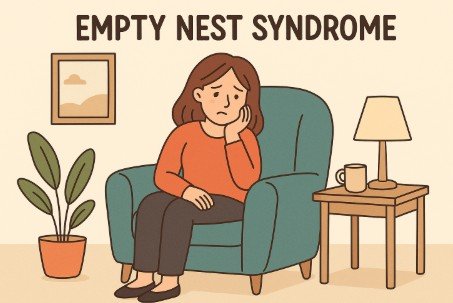
No one really prepares you for the moment when the house goes from loud, chaotic, and full of life… to eerily quiet. One minute you’re stepping over shoes, reminding someone (again) to unload the dishwasher, and negotiating curfews. The next? You’re standing in the kitchen wondering why it’s so clean — and why that feels strangely unsettling.
Empty nest syndrome isn’t just missing your kids; it’s adjusting to a new version of yourself. Your role shifts overnight, and suddenly you’re left asking, “So… now what?” You’re proud, sad, relieved, nostalgic, and lonely — sometimes all before lunch. And yes, it’s completely normal to feel all of it at once.
The good news? This quieter chapter isn’t the end of your story — it’s a plot twist. One that gives you space to reconnect, rediscover, and maybe even enjoy not sharing the bathroom. Eventually, the silence gets less heavy… and starts to feel like possibility.
So Your Kids Left Home. Now What?
A brutally honest guide to Empty Nest Syndrome (spoiler: you’ll survive… probably with snacks and sarcasm)
Okay friend, listen. Nobody warned us about this part. Everyone preps you for sleepless newborn nights, the terrible twos, and the full-blown psychological thriller that is puberty. But Empty Nest Syndrome? Nope. That little plot twist just sneaks up like a cat knocking something off the counter while making eye contact.
One minute you’re whining about Mount Laundry and a grocery bill that rivals the GDP of a small nation. The next? Silence. Glorious. Unsettling. “Why is it so quiet and why do I suddenly feel weird about it?” silence.
Honestly, for a long time it didn’t even feel like my kids had moved out. It was more like a very long, very confusing game of musical chairs.
My stepdaughter had been living with her partner, so technically she was gone… until life happened. The relationship ended, the job disappeared, and boom—she was back home. Surprise!
My oldest stayed home for her first year of university thanks to lovely little COVID, then went away to school for four years.
My youngest went away for school too, quit her program, worked her summer job, and stayed with her boyfriend’s parents. Then she went back to school and moved into a student apartment.
So really… had anyone actually moved out? Or were they just aggressively rotating locations?
Then my daughter finished school and moved in with her boyfriend. And that—that was the moment. The “oh crap” moment. The realization that this wasn’t temporary. My kids weren’t just visiting adulthood; they were unpacking there.
That’s when it hit me: my kids are growing up. They’re building lives, making choices, and moving forward. And while I’m incredibly proud… I’m also standing in a quiet house wondering who drank all the milk when nobody’s even home.
So yes, the nest is emptier. But here’s the thing no one tells you: you’re still here. You survived diapers, drama, and Door-Slamming Teenage Years. You can survive this too.
And hey—at least now the snacks you buy actually last longer than 24 hours. 💁♀️
The Five Stages of Empty Nest Grief (That Nobody Talks About)
Stage 1: Denial
“This is AMAZING! I can finally watch my shows without someone yelling ‘What’s for dinner?’ every five minutes!”
You deep-clean their room like you’re auditioning for a home makeover show. You reorganize the pantry. You alphabetize spices. You convince yourself this—this right here—is the freedom you’ve been waiting for.
Except… not really.
Like I mentioned earlier, it honestly didn’t even feel like my kids had moved out. It was more of a “they’re kind of gone but also kind of not” situation. My stepdaughter is still with us, so technically we’re not empty nesters at all. We’re more like empty-nest-curious.
We’re standing on the edge of it, peeking over, saying, “Oh wow, that looks nice,” while also whispering, “But please don’t move too far away.” Because yes, we’re looking forward to being empty nesters… eventually. The quiet sounds lovely. The freedom is tempting.
But do we still want our kids close? Around? Dropping by? Eating our food? Absolutely. Well—at least I do. Let’s be honest, I want the best of both worlds: independence and random visits where they magically appear when the fridge is full.
Denial, after all, isn’t just pretending they’re gone. It’s pretending you’re totally ready for it when you’re very much not. And that’s okay. 💕
Stage 2: Bargaining
This is where the texting starts. And by starts, I mean escalates rapidly.
“Just checking in!”
“How’s the weather there?”
“Did you eat today?”
You are basically one emotionally charged decision away from tracking their location like they’re still 16 and you’re totally normal about it.
Real talk: if you’ve texted your kid three times before noon to confirm they’ve had breakfast, congratulations—you are deep in the bargaining stage. It’s fine. This is a judgment-free zone. We’ve all been there.
Sometimes they text me back right away, which gives me false hope and dopamine. Other times… it takes a few days. DAYS. I try to stay calm, but let’s be honest—I’m mentally drafting my will by hour 36.
Now, I will admit: I still pay for the cell phones of the two youngest. And yes, I absolutely consider that leverage. Am I proud? No. Will I use it? Also no. But do I know it exists? Absolutely.
In six months, though, that safety net disappears. My oldest will be responsible for her own phone bill. Her own bills. I honestly don’t know what I’ll have to hold over her head to return my calls. Emotional guilt? Home-cooked meals? “Accidentally” etransfer-ing her money and reminding her I exist?
That step—when she takes over her phone and car insurance—that’s really the beginning of full-blown adulthood. Sure, some of my bills will be lower (and I am looking forward to that, let’s be clear). But emotionally? That’s the moment where bargaining officially stops working.
So here I am, enjoying slightly fewer bills, slightly more silence, and realizing I’m running out of things to negotiate with.
Anyway… onward to Stage 3. 😅
Stage 3: The Identity Crisis
And now we arrive at the big, slightly uncomfortable question:
Who are you when you’re no longer parenting someone 24/7?
For years, “Mom” or “Dad” wasn’t just a title—it was your entire personality. You didn’t have hobbies, you had schedules. You didn’t have interests, you had carpools. Now suddenly the lunches are unpacked, the permission slips are gone, and you’re standing there thinking… Wait. Is there still a person under all this?
Apparently, yes. But she’s a little rusty and hasn’t been asked what she wants in years.
Also, side note: my kids didn’t even call us the same thing over the years. After “Mommy,” my oldest decided to upgrade me to Mother.
MOTHER.
I don’t know what image that word brings up for you, but for me it was cold hallways, distant parents, and children being shipped off to boarding school while their parents politely forgot their names. I hated it. My daughter, however, thought it sounded very grown-up and sophisticated. Meanwhile, I was internally screaming, “I AM STILL WARM AND AFFECTIONATE, THANK YOU.”
Thankfully, I’ve now been downgraded—sorry, upgraded—to Mum. Sweet, familiar, comforting. Huge relief. My identity is no longer “emotionally distant Victorian parent.” Progress.
My youngest, meanwhile, went through a phase of learning German in her teens, which resulted in some… creative naming. Her dad is still “Vader” (yes, like Darth Vader, and honestly that tracks. He is a huge Star Wars fan). But at least I stayed Mom. I survived the linguistic experiment.
I know I’ll always be Mum or Mom—and I’m grateful for that. But I won’t lie… I loved being Mommy. That version of me felt soft, needed, and very much at the center of their world.
So yeah. Stage 3 is realizing you’re still you, just without the constant chaos. And maybe—just maybe—learning how to hold onto who you were, while figuring out who you’re becoming next. 💕
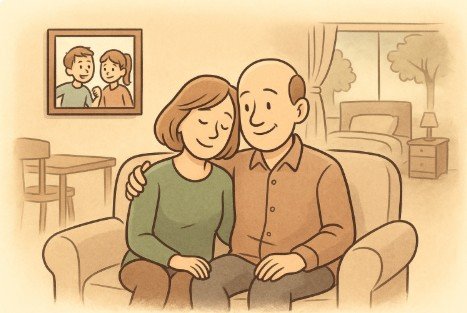
What Nobody Tells You (But I Will)
The hardest part isn't missing them—it's missing who *you* were when they needed you. Parenthood gave you purpose on a silver platter. Now? You've got to figure out your purpose yourself. How utterly inconvenient.
"I spent 18 years making sure someone else was okay. Now I have to figure out if I'm okay? This wasn't in the parenting manual."
But here's the thing they don't show in the Hallmark movies: this is actually your chance to become interesting again. Remember hobbies? Remember having thoughts that didn't revolve around school schedules and what's for dinner?
The Ridiculous Things You'll Do
You'll keep making too much pasta. You'll set the table for four instead of two. You'll hear a noise at 11 PM and think "they're home!" before remembering they live 500 miles away now.
You'll also do weirder things, like:
• Walking past their empty room and feeling like you're in a museum
• Getting unreasonably emotional at Walmart (or browsing Amazon) in the back-to-school section
• Considering getting a dog, a cat, or possibly a llama to fill the void
• Stalking their social media like you're training for the FBI
Pro tip: The dog will love you unconditionally and never roll their eyes at your jokes. Just saying.
The Plot Twist
Eventually—and I promise this happens—you'll realize something strange. You kind of... like this? The quiet. The spontaneity. The ability to eat cereal for dinner without judgment. The relationship you have with your partner (or yourself, or your friends) without the constant background noise of parenting.
Your kids will call. They'll ask for advice. They'll need you in different ways. And you'll be there, because that part never changes.
But you'll also be living your own life. Finally. Again. Whatever.
So What Now?
Give yourself permission to feel weird about this. Give yourself permission to miss them and also enjoy sleeping past 7 AM. Give yourself permission to be more than just someone's parent.
Because here's the truth: you did your job. You raised a human capable of leaving. That was literally the entire point. Congratulations, you succeeded. Now the next chapter is about figuring out what success looks like for you.
No pressure or anything.
And if all else fails, there's always wine and group therapy. Preferably in that order.

Navigating Menopause: When Your Body Writes Its Own Script
Menopause: The Unscripted Adventure No One Warned You About
Menopause doesn’t come with a manual — or a warning. Some of us sail through like our grandmothers, lucky ducks, while others get blindsided by symptoms no one even whispered about. Night sweats that turn your bed into a water park, random periods that pop up like surprise guests, or skin so itchy it’s auditioning for a horror movie — it’s all part of the hormonal rollercoaster.
And let’s be honest: the mirror doesn’t lie, but it also doesn’t tell the full story. Inside, you feel like your 35-year-old self, but outside? Your body is clearly writing its own dramatic narrative. The good news? Understanding what’s happening, arming yourself with a few survival strategies, and knowing when to call in the pros can make this journey a lot less chaotic — maybe even occasionally funny.
Whether your experience is mild, extreme, brief, or marathon-long, it matters. And no matter what anyone says, you are never too young, too old, or too tired to advocate for your health — and yes, that includes demanding support, sanity-saving advice, and maybe even a little extra wine.
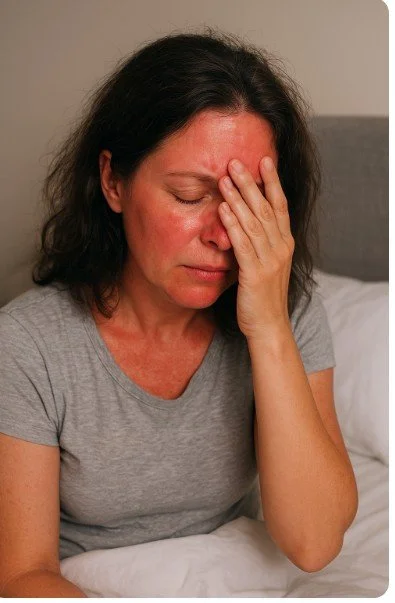
woman having a hot flash at night AI generated
We get all sorts of lovely hand-me-downs from the women before us — grandma’s recipes, mom’s mannerisms, maybe even an unfortunate family name or two. But menopause? Oh no. That’s where our bodies suddenly decide to go “Thanks for the lineage, ladies, but I’m gonna freestyle this one.”
Because of course the one thing we want to predict is the one thing that shows up like, “Surprise! I do what I want.”
The Myth of the "Typical" Experience
My grandmother's life was a testament to resilience. Born in the early 1900s, she became a single mother in her 20s—no small feat for a woman of her generation. She married my grandfather in her 30s and had three more children with him. Her final pregnancy, when she was carrying what would have been a boy, ended in heartbreak. The baby was born around seven months and didn't survive.
What happened next shaped her experience of menopause in an unexpected way. As she told me years later, she simply never got her monthly again after that final pregnancy. Just like that, in her late 30s, her body made a decision. No gradual tapering, no years of irregular cycles, no hot flashes she ever mentioned. Her periods stopped, and she moved forward with the same quiet strength she'd shown through everything else.
Hearing her story, I was convinced I'd inherited this trait. Surely I'd be like my grandmother—sailing through menopause in my early 40s without fanfare. Reality had other plans.
For years in my 40s, I knew something was shifting. My previously reliable cycle became unpredictable, yet when I asked doctors to check my hormone levels, I was repeatedly told I was "too young." By my late 40s, my body went haywire—periods every few weeks, then months of nothing. Night sweats appeared suddenly at 50, then vanished just as mysteriously. Fourteen months after what I thought was my last period, I had one more small reminder. That was nine years ago.
Don't get me wrong—I did not sail through menopause like my grandmother appeared to. Though honestly, I'm not sure she really did. There's just something you don't share with someone in their late teens or early 20s when you're in your 70s. And honestly, she might’ve had her own menopausal saga — she just never said a word. Women back then kept quiet about everything, like it was some sort of Olympic event in silent suffering.
As for me? Oh, I’ve had the whole sampler platter of symptoms. Sleepless nights? Check. Skin so itchy I’m shocked I haven’t clawed myself like a cat with an attitude problem? Double check. My hair’s drier, my skin has its own storyline, and don’t even get me started on my reflection. I look in the mirror and think, “Who is that?” because in my mind, I am — and forever shall be — 35.

women with menopause symptoms AI generated
Common Menopause Symptoms
I am not a physician or medical professional. The information shared here is based on what I have found through various sources and personal research. It is intended for general information only and should not be considered medical advice. Please consult a physician or another trusted healthcare professional regarding your own health concerns or questions.
While every woman's experience is unique, certain symptoms appear frequently during perimenopause and menopause and seem to be a natural response to aging:
Irregular periods - Often the first sign, cycles may become shorter, longer, heavier, lighter, or wildly unpredictable before stopping altogether.
In perimenopause, hormone levels (especially estrogen and progesterone) fluctuate, so cycles often become shorter, longer, heavier, lighter, or skipped before stopping for 12 consecutive months.
This irregularity can last several years and is usually normal, but very heavy bleeding, bleeding after sex, or bleeding after 12 months without a period should be evaluated by a clinician.
I did have one random, surprise period after 14 months — because of course my body couldn’t just let me celebrate in peace. At the time, I didn’t go running to the doctor, though I absolutely would have if it happened again or came with any other weird side quests. Honestly? I didn’t even realize it was something I should be mildly alarmed about. I’d heard so many mixed messages about menopause that I just chalked it up to “yet another bizarre thing my body is doing for reasons unknown.”
Vasomotor symptoms (Hot flashes and night sweats) - Sudden waves of heat that can disrupt sleep and daily life are among the most common menopause complaints; large reviews estimate that roughly half or more of midlife women experience them globally, with some regional variation.. They may last months or years, or barely appear at all.
These episodes can disrupt sleep, concentration, and work performance; some women have only mild occasional flashes, while others have frequent, intense symptoms for many years.
I went through a few solid months of night sweats — the kind where you wake up feeling like you’ve been sleeping in a slow cooker — but luckily I dodged most of the classic hot flashes. Silver linings, right?
But my body has definitely become extra dramatic about temperature. Too hot, too cold… apparently I’m Goldilocks now. I remember getting the same “thermostat gone rogue” vibes when I was pregnant, so I’m guessing it’s hormone-related — though I have zero medical proof and my degree in Googling symptoms is not exactly accredited.
If anyone else has dealt with this little temperature circus, I’d honestly love to hear your take.
Sleep disturbances - Whether from night sweats or hormonal changes, insomnia becomes an unwelcome companion for many women.
Difficulty falling asleep, frequent night waking, and non‑restorative sleep affect about half of midlife women and is often linked to both night sweats and direct hormonal effects on sleep regulation.
Poor sleep then feeds into daytime fatigue, mood changes, and “brain fog,” creating a cycle that can significantly impair quality of life.
I’m still battling those lovely sleepless nights — because apparently my brain thinks 3 a.m. is the perfect time to relive every embarrassing moment from 1994. My go-to fixes? I’m not saying they’re doctor-approved, but I sometimes slap magnesium oil on the bottoms of my feet or pop a melatonin. Most of the time, they do the trick.
Although… now I’m side-eyeing melatonin after stumbling across an article hinting at a possible link to heart disease. Fabulous. Just what we needed — another thing to overthink at bedtime. I’ll dig into the actual research before tossing the bottle into the trash, though.
And listen, I used to unwind with a glass of wine after work. It was my tiny nightly reward for surviving adulthood. But after reading a few too-many “concerning articles,” I’ve dialed it back. Not gone forever — just not an every-evening habit anymore. Yet again, something else added to my “must research when I have the energy” list.
When all else fails? I just get up and read for a bit. Honestly, I’ve learned that a couple bad nights don’t mean I’m doomed — usually, a good solid sleep eventually swoops in like a hero sliding into the last 15 minutes of an action movie..
Skin changes - Dryness, itching, and changes in texture and elasticity. Estrogen helps maintain collagen, skin thickness, and moisture, so declining levels contribute to drier, thinner, less elastic skin and can make wrinkles and sagging more noticeable. You might look in the mirror and not quite recognize the face looking back, even though you still feel 35 in your head.
I moisturize every single day — it’s basically my long-standing religion at this point, thanks to my naturally dry skin. Sadly, the itchiness did not get the memo and continues to do its own thing. So far, nothing I’ve tried has made much of a difference, and I’m running out of lotions that don’t claim to be “life-changing.”
If anyone out there has cracked the code on this itchy nonsense, I would love to hear your wisdom. Honestly, at this point I’ll take tips, tricks, old wives’ tales — whatever you’ve got.
Hair changes - Thinning, dryness, and changes in texture are common as estrogen levels decline.
Many women also report hair thinning, dryness, or changes in texture around menopause, related to hormonal shifts and, in some cases, genetic pattern hair loss becoming more visible.
I’ve always had thick hair — the kind that makes you feel like you’re carrying a small animal on your head. But lately, the texture has thrown me for a loop. Sure, it’s always been a bit on the dry side, but now it’s practically auditioning for a role in Desert Hair: The Musical. My scalp has joined the rebellion too, sprouting dry patches like it’s going out of style.
I tried a shampoo and conditioner made for dry scalps, which helped… a little. But now some of the dryness is creeping back, so I might have to play product roulette again. Winter seems to be the main culprit — apparently my hair and scalp are seasonal divas.
Mood shifts - Irritability, anxiety, and low mood can accompany hormonal fluctuations.
Irritability, anxiety, low mood, and emotional lability are frequently reported during the transition, and studies show that pre‑existing mood or anxiety disorders can temporarily worsen at this time. Cognitive symptoms such as forgetfulness, trouble finding words, and difficulty concentrating are commonly described; research suggests they are real but usually mild to moderate and often improve over time rather than progressing like dementia
Brain fog - Difficulty concentrating and memory lapses that can be frustrating and unsettling.
I can totally relate to losing words and forgetting things. My once-sharp memory has definitely taken a bit of a vacation. It’s especially embarrassing when I’m in the middle of a presentation and suddenly my brain swaps out the exact word I need for some very basic, everyday substitute. You know — when the fancy word disappears and all you’re left with is “that thing… you know… the thing.”
I was starting to get a little concerned about it, to be honest. Then, during a casual chat with a neighbour who’s around my age, we somehow landed on the topic of memory and our shared worries. She told me about a book she was reading — written by a neuroscientist — and explained that what we were experiencing was actually quite normal.
I bought the book immediately (because of course I did). And honestly? It made me feel so much better. Knowing that this kind of memory slip is a natural part of aging was incredibly reassuring. Now if only it could help a little more with word retrieval… because standing there mid-sentence, hoping the right word magically shows up, is still a daily adventure. 😅
Vaginal dryness - Decreased lubrication and tissue changes that can affect comfort and intimacy. Loss of estrogen leads to thinning and drying of the vaginal and vulvar tissues and can reduce natural lubrication, causing discomfort, burning, or pain with intercourse (part of what is now called genitourinary syndrome of menopause).
These changes, along with possible reductions in libido and sleep/mood problems, can affect intimacy, but local vaginal estrogen, non‑hormonal moisturizers and lubricants, and open communication often help significantly.
Okay… vaginal dryness.
There, I said it. Honestly, this topic feels a little personal — like the kind of thing you whisper to your best friend over a glass of wine while pretending the waiter can’t hear you. But here we are.
I did notice some… let’s call them “changes” in my pelvic floor, and like many of us, I tried to fix it myself with Kegels. Because of course isn’t that the magic answer to everything from childbirth recovery to solving world peace?
Apparently not.
Things started getting worse, so I finally went to a pelvic floor specialist. And you know what she told me?
“Stop doing Kegels.”
Excuse me?
Turns out the muscles around my bladder were too tight, and all those Kegels were basically making me the overachiever no one asked for. She actually had me start doing reverse Kegels, which I didn’t even know existed. Reverse! Who knew there was a backwards version of something I barely understood forward?
She also suggested I talk to my doctor, who prescribed HRT suppositories. They definitely helped — though I can’t say everything is fully cured.
Let’s just say… it’s better. Mostly. On good days.
And on other days?
Well…
Let’s just say the word “Depends” suddenly feels like both a joke and a lifestyle choice. 😉
Alright, let’s dive into the glamorous world of… menopause.
I know, I know — not exactly the spa day we ordered.
So here we are, talking about something we’d honestly prefer to pretend isn’t happening. People keep telling us, “Oh, women have gone through this since the dawn of time!” Sure, but also… did they? Life expectancy back then was much shorter, and most women spent their “golden years” churning butter or dodging plagues. If they hit 50, I’m pretty sure they were too busy being alive to complain about hot flashes.
On the other hand, we get the extended edition of this whole hormonal circus — lucky us!
But hey, if we’re living longer, we might as well live comfortably, right?

What You Can Do On Your Own
(aka: Ways to Survive the Daily Surprise Parties Your Body Throws Without Warning)
While medical intervention is sometimes necessary, many women find relief through self-care strategies:
For hot flashes and night sweats
Aka “internal spontaneous combustion.”
• Dress in layers you can dramatically rip off mid-conversation
• Keep your bedroom cold enough to store meat
• Watch out for spicy foods, caffeine, and alcohol — basically all the fun things
• Own a tiny fan you can whip out like a Victorian lady having a moment
For skin itching and dryness
Because apparently we’re turning into lizards now.
• Use gentle, fragrance-free moisturizers right after bathing
• Cooler, shorter showers (sorry… long steamy showers, it’s not you, it’s menopause)
• Add a humidifier to your home — bonus, plants love it
• Colloidal oatmeal baths if you’re feeling itchy and fancy
• Hydrate like it’s your full-time job
For sleep problems
Insomnia: the gift that keeps on giving.
• Keep a consistent bedtime routine (yes, like a toddler)
• Kick electronics out of your bedroom — doomscrolling and sleep do not mix
• Try deep breathing or progressive muscle relaxation
• Avoid caffeine after noon unless you want to stare at your ceiling all night
For hair and scalp dryness
Because why shouldn’t our hair join the rebellion?
• Switch to sulfate-free shampoos
• Ease up on heat styling (your hair will thank you)
• Deep-condition like you’re auditioning for a shampoo commercial
• Silk or satin pillowcases — luxurious and practical
For overall wellbeing
Aka keeping your sanity intact.
• Move your body — exercise helps mood, sleep, and bones (basically everything except folding laundry)
• Eat balanced meals rich in calcium and vitamin D
• Stay connected with your people — girl chats are medicinal
• Try yoga, meditation, journaling, or whatever helps you feel grounded
• Join menopause support groups — because nothing bonds women like sharing hot-flash horror stories

woman getting help with menopause symptoms. AI generated
When to Seek Medical Help
Sure, we like to think we’re total badasses — and honestly, we are — but even warriors sometimes need a little reinforcement.
(And no, “reinforcement” does not just mean pouring another glass of wine… tempting as that may be.)
Reach out to your doctor if:
• Your symptoms are steamrolling your quality of life
• You’re dealing with heavy or prolonged bleeding
• You have bleeding after 12 months without a period
• Your mood has dipped into depression or severe anxiety territory
• Home remedies have failed, the wine is no longer cutting it, and you’re one hot flash away from flinging your poor fan across the room in a dramatic meltdown
The Bottom Line
Menopause? Yeah, it doesn’t come with instructions, a script, or even a polite warning. You might glide through it like your grandmother did — lucky her — or you might get hit with symptoms she never once mentioned, probably because she was too busy keeping a stiff upper lip and pretending everything was fine. You might be waiting for the dramatic, headline-worthy changes everyone warned you about, while quietly suffering through the sneakier stuff — night sweats that turn your bed into a water park, relentless itching, or those glorious nights spent starring at the ceiling like it owes you an explanation.
And let’s talk about that mirror disconnect. Your body is out here doing its own thing, telling a story you didn’t sign up for, on a timeline that’s clearly off-script. Meanwhile, your brain is like, “Wait, wasn’t I supposed to still look 35?”
Here’s the thing: understanding what’s happening, having a few tricks in your back pocket, and knowing when to call in the pros can turn this hormonal rollercoaster from total chaos into… well, something a little more survivable.
Your experience is valid — whether it’s a minor blip, a full-blown circus, a one-night wonder, or a multi-month saga. And no matter what anyone might tell you, you are never too young, too old, or too “whatever” to advocate for your health and demand the support (and sanity-saving advice) you deserve.

Embracing Movement After 50: A Personal Journey and Practical Guide
Embracing Movement After 50
Age is not a limitation—it's an invitation to move with intention, strength, and joy. After 50, your body craves movement that honours where you've been while building where you're going.
Whether you're rediscovering fitness or maintaining lifelong habits, this is your time to embrace exercise that energizes rather than exhausts, strengthens rather than strains, and celebrates what your body can do today.
From gentle stretching and walking to strength training and balance work, movement after 50 is about sustainability, not intensity. It's about waking up feeling capable, staying independent, and moving through life with confidence and vitality.
Your body has carried you this far—let's keep it moving forward.
My younger self was one of the lucky ones — thin, active, and seemingly able to eat what I liked without gaining weight. In my 20s, I was a gym rat—the kind who'd spend hours there happily moving between stretching, cardio, and weights. I wasn't bodybuilder-level, but I was strong and I had abs I was proud of. But life happens; full-time work, raising children, evenings spent doing courses instead of hitting the gym. Exercise became something I had to fit in, rather than something I simply loved.
The weight came off quickly after my first child, but after my second, those last few pounds stubbornly remained. In my 40s I noticed the weight creeping up. Then I turned 50 … and suddenly weight seemed to want to be my new best friend. I saw changes in areas I never worried about in my 20s and 30s. I tried everything: Noom, a nutritionist, Weight Watchers. They all worked — if I followed the plan perfectly. The problem? I never truly learned how not to eat whatever I wanted. The relationship I once had with food, had fundamentally changed.
Now, keeping fit in my 50s feels vastly more challenging. But it is possible. With a few smart updates to how I approach movement and health, I’m discovering a way of staying active that honours both the body I have now and the one I used to have.
Why Moving Matters (Especially After 50)
Good news: becoming more active isn’t just about chasing the "old you" — it’s about finding the best you at this stage of life.
Here's what I've learned from all the reading I've done: movement matters—more than I realized. Staying active after 50 isn't just about looking good or maintaining weight. It genuinely helps us live longer and feel better. Things like brisk walking, cycling, or jogging support heart health and longevity. Strength training becomes crucial because it fights the natural muscle loss that accelerates as we age, protects our bones, and helps with balance. And the benefits go beyond the physical. I've noticed that when I'm moving regularly, my mood is better, my thinking is clearer, and I just feel more capable of handling whatever life throws at me. So yes — even if your younger self was lean and active, the game changes in your 50s. And that’s okay. You’re not just maintaining, you’re adapting.
What’s Changed (And What to Do Differently)
From my own experience, here are some of the shifts I’ve noticed and the adjustments that have helped.
Slower metabolism & changing body composition
It feels as though the body that easily drifted along in previous decades now resists. Here's what I've noticed:
I'm losing muscle without even trying. Strength that came naturally before now requires intention and effort to maintain.
Weight gravitates to different spots. My 20s and 30s blessed me with easy abs and arms I never thought about. My 50s? Fat accumulates around my back, hips, and midsection in ways that feel entirely new.
Everything metabolically shifted after menopause. My body's relationship with food and energy changed fundamentally. The rules are different now.
What to do:
Add strength training 2–3 times a week. The goal isn't a bodybuilder physique—it's about feeling strong and capable in daily activities.
Give more attention to protein intake, quality sleep, and nutrient-dense foods. Recovery becomes increasingly important, and nutrition directly impacts energy and well-being.
Let go of calorie-counting mentality. Shift focus to building strength and sustaining consistent movement. This reframing creates a healthier, more sustainable approach.
Movement must evolve
The body at 25 can handle almost anything. At 50, joints, recovery time, and energy levels require a more thoughtful approach.
Aerobic exercise remains essential. Brisk walking, jogging, or cycling all support cardiovascular health and help reduce disease risk.
Strength and resistance work becomes more crucial with each passing year—it's what maintains muscle, protects bones, and keeps the body functional.
Gentle, low-intensity movement matters too, especially for anyone starting fresh or easing back into fitness after a break.
What to do:
Set a realistic weekly goal: aim for 150 minutes of moderate aerobic activity and 2 strength sessions per week.
Choose exercises that protect joints, enhance balance, and reduce injury risk (e.g., bodyweight squats, resistance bands, walking uphill, Pilates).
Make it regular — even short bursts of movement are meaningful.
Mindset shift: from “working out” to “moving for life”
In my 20s I went to the gym to maintain weight or counterbalance a slice of cake. In my 50s it’s more about longevity, strength, and health.
What to do:
Reframe exercise as a form of self-care and prevention—not punishment.
Recognize that the body you have today is different — and deserving of its own best practice.
Embrace movement you enjoy (friend walks, biking, dance, pickle ball) so consistency is more likely.
Tips that helped me:
• Consistency over intensity: Some days I simply walk; other days I lift (or plan to).
• Build habit, not perfection: Some weeks I work out consistently. Other days I veg and watch TV. That’s life.
• Recovery matters: Good sleep, mobility work, and rest days help me feel ready.
• Nutrition supports everything: I aim to eat for health and energy, not just weight.
• Enjoyment = longevity: If it feels like a chore, I’m less likely to stick with it. I pick movement I like.
Final Thoughts
Turning 50 brought with it a realization: staying fit is no longer simply about being lean or chasing curves. It’s about sustaining mobility, enjoying life, preventing decline, and feeling strong in this version of me.
My younger self might have scoffed at a 30-minute walk or thought resistance bands were a substitute. But my 50-something self knows this: movement is everything. Strength matters. The body that supports my kids, career, hobbies, friendships is worth investing in.
If you’re there too — navigating the changes, noticing the shifts, wondering “what now?” — know this: you’re not starting late. You’re simply starting right. Be kind to yourself. Celebrate progress, not perfection. And keep moving forward.
Consistency is the hardest part for me! What are some of your best mental trick or routine secret for staying motivated and getting out the door on a day you just don't feel like it?
Here are some of the websites I have used for staying fit:
• Hoag Foundation. https://www.hoag.org/aspire/the-benefits-of-staying-fit after-50/ Hoag
• WebMD. https://www.webmd.com/healthy-aging/what-to-know-about-running after-fifty WebMD
• AARP. https://www.aarp.org/pri/topics/health/prevention-wellness/physical activity-exercise-benefits/ AARP
• Stanford Longevity Center. https://longevity.stanford.edu/lifestyle/2024/07/02/recommended-exercises for-adults-50/ longevity.stanford.edu
Feel free to use these as starting points to build your own plan, adjust as you learn what your body responds to, and enjoy the journey of movement after 50!
What have you done to stay active and fit in your 50’s
Women exercising

Navigating distant family holidays as parents age
When the Holidays Highlight the Distance
The holiday season has a way of highlighting how families evolve over time. My parents are aging, and the distance between us feels more significant with each passing year. I'm settled 2,000 kilometers away in another province, while my brother works an offshore rotation—three weeks on the rigs, three weeks off. This Christmas, they'll be spending the holidays alone.
When I talk to them, they reassure me they're fine, that they've grown accustomed to our absence. But I hear what they don't say. I know it's difficult, especially when they see other family members surrounded by children and grandchildren while their own family connects from a distance.
A memory surfaces: my grandmother at Christmas, watching the door, singing softly about wishing it would open to reveal my uncle and his family of six who lived far away. Now I realize my parents must feel exactly the same way.
As I watch this unfold, I can't help but think about my own future. One day, my children will have their own lives, their own distances to manage. The hardest part is accepting that family life evolves, and the crowded, chaotic gatherings of childhood may not be sustainable forever. But that doesn't mean the love diminishes—it just finds new expressions.

family at Christmas with members on laptop
The holiday season has a way of highlighting how families evolve over time. My parents are aging, and the distance between us feels more significant with each passing year. I'm settled 2,000 kilometers away in another province, while my brother works an offshore rotation—three weeks on the rigs, three weeks off. This Christmas, they'll be spending the holidays alone. Between flight costs for my family and my brother's work schedule, neither of us can make it home.
When I talk to them, they reassure me they're fine, that they've grown accustomed to our absence. But I hear what they don't say. I know it's difficult, especially when they see other family members surrounded by children and grandchildren while their own family connects from a distance.
The guilt weighs heavily on both sides. I struggle to balance creating meaningful holidays for my own family while carrying the knowledge that my parents are alone. Meanwhile, my brother and I are navigating new territory ourselves—this year, for the first time, I suggested we stop exchanging gifts for our kids. They're older now, more independent, and the gift exchange has started to feel like a transaction rather than something meaningful. But without that tradition, how do we show we're thinking of each other during the holidays?
I find myself unsure how to navigate this new phase—with aging parents on one side and grown children on the other.
A memory surfaces: my grandmother at Christmas, watching the door, sighing softly about wishing it would open to reveal my uncle and his family of six who lived far away. Now I realize my parents must feel exactly the same way.
My brother is planning a visit before his next rotation, but it'll be three weeks before Christmas. Close, but not quite the same. Still, you adapt. You find ways forward.
As I watch this unfold, I can't help but think about my own future. One day, my children will have their own lives, their own distances to manage. When that time comes, I'll need strategies for coping with holidays that look nothing like the crowded, noisy gatherings I remember from childhood—tables full of grandparents, aunts, uncles, and cousins, all the beautiful chaos of family together in one place.
Here are some practical suggestions for managing these family transitions during the holidays:
Rethink When You Celebrate The calendar date matters less than being together. Consider celebrating Christmas in early January, late November, or whenever schedules align. Creating your own "family Christmas" on a different day can feel just as special and removes the pressure of impossible logistics.
Embrace Technology Meaningfully Schedule video calls during key moments—opening gifts, preparing meals, or just sharing coffee. Some families set up tablets at the dinner table so distant members can "join" the meal. It's not the same as being there, but it creates connection beyond a quick phone call.
Create New Traditions That Span Distance Watch the same movie at the same time while on a call. Send care packages that arrive on Christmas Eve with instructions to open together over video. Start a shared digital photo album where everyone posts holiday moments throughout the season. These rituals acknowledge the distance while building something meaningful across it.
Plan Rotating Gatherings If annual visits aren't feasible, commit to gathering every two or three years. Knowing there's a plan—even if it's far out—gives everyone something to anticipate and makes the in-between years feel less permanent.
Shift Gift-Giving Focus Instead of exchanging gifts between siblings, pool resources for your parents—perhaps funding a house cleaning service, meal delivery, or an experience they'd enjoy. For kids, consider donating to a charity in each other's names or doing a family gift exchange game when you do gather.
Send Presence, Not Just Presents Mail handwritten letters, voice recordings, or photo books that arrive before the holidays. These tangible reminders that someone took time to create something personal can mean more than store-bought gifts.
Check In More Throughout the Year Regular contact during ordinary months can ease holiday guilt. A Tuesday afternoon video call in March might matter more than you think, making the holidays feel less like the only time connection happens.
Accept the Grief Acknowledge that this transition involves loss—loss of traditions, of the family structure you once knew. It's okay to feel sad about what's changing while also embracing what's ahead. Give yourself and your parents permission to miss the old days without guilt.
Create Micro-Moments Even if you can't be there Christmas Day, could you manage a long weekend visit in December? Sometimes a few days together earlier in the season, without the pressure of "the perfect Christmas," can feel more relaxed and meaningful.
Start Conversations Now Talk openly with your parents and siblings about what matters most to everyone. You might discover your parents would prefer a summer visit when the weather's better over a stressful December trip you can barely afford. Their priorities might surprise you.
The hardest part is accepting that family life evolves, and the crowded, chaotic gatherings of your childhood may not be sustainable forever. But that doesn't mean the love diminishes—it just finds new expressions.

Finding and Nurturing Friendships After 50: A New Chapter in Connection
Friendships after 50 require something they rarely needed in our youth: intentionality. As we navigate retirement, relocations, and life transitions, the casual connections that once sustained us give way to deeper, more deliberately chosen relationships. Distance scatters old friends across the country, while making new ones feels simultaneously more challenging and more essential than ever. Yet research shows these connections aren't just nice to have—they're vital to our health, reducing cognitive decline by up to 70 percent and adding years to our lives. From scheduling regular traditions like theatre subscriptions to joining community groups and leveraging technology, maintaining and building friendships in this season requires effort, vulnerability, and a willingness to reach out first. The reward? Relationships that are more authentic, purposeful, and profoundly sustaining than anything we've known before.
When I was young, friendships were somewhat easy. There always seemed to be friends to hang around with, people to call on a whim, groups to join spontaneously. Looking back now, I'm not entirely sure if I really nurtured those relationships for the long haul, or if I simply enjoyed the moment. Yet somehow, some of those early connections endured. I still consider some of them friends, even though we don't hang out all the time anymore. Life has a way of reshaping our social landscapes, doesn't it?
The Evolution of Friendships Through Life's Seasons
Eventually, life happens, and friendships change in ways we never quite anticipate. We marry and suddenly find ourselves part of a couple, surrounded by other couples. We have kids, and suddenly our social circles revolve around playdates, school activities, and soccer games. Our friendships become intertwined with our children's lives—parents we chat with at drop-off, families go to competitions with, people we see at every school event.
Now that I'm in my 50s, living a couple of hours from where I spent most of my career, I've discovered that finding friends seems to be more difficult in some ways and yet easier in others. It's a paradox that catches many of us off guard during this life transition.
The Challenge of Geographic Distance and Life Changes
Living in a newer neighborhood has helped some. I've made a few friends with neighbors, though these friendships sometimes feel like they exist in a different category—friendly waves over the fence, occasional get-togethers, but perhaps not yet the deeper connections I crave. The friends I've had for a number of years now live much further away. Some have moved in opposite directions after retirement.
These long-standing friendships face a real risk. If we don't actively nurture and keep in touch, they may fade over time. The distance makes it easy to let weeks, then months, slip by without real connection. Yet these are often the people who know us best, who remember who we were before life's various transformations.
Why Friendships Matter More Than Ever After 50
Before diving into strategies for maintaining and building friendships, it's worth understanding why this matters so profoundly. Research consistently shows that social connections are fundamental to healthy aging. Strong friendships can reduce the risk of early death, while social isolation carries health risks comparable to smoking cigarettes daily.
The health benefits of friendship are remarkable and far-reaching:
Mental Health Benefits: Friendships provide a crucial buffer against depression and anxiety. People with robust social networks experience significantly lower rates of depressive symptoms and have better cognitive function as they age. In fact, strong social connections can reduce the rate of cognitive decline and dementia by up to 70 percent.
Physical Health Advantages: The benefits extend well beyond mental well-being. People with strong social ties have lower blood pressure, reduced inflammation, and a lower risk of cardiovascular disease. Those who maintain active social lives are less likely to develop heart disease and less likely to experience a stroke. Social connection even strengthens the immune system, helping people fight off illnesses and recover more quickly when they do get sick.
Longevity: Perhaps most striking, maintaining meaningful relationships may actually slow the aging process at a cellular level. Research examining DNA-level changes suggests that older adults with the most supportive relationships were aging one to two years slower than those who lacked such connections.
Strategies That Work: Intentional Connection
One friend and I have found a solution that works beautifully for us. We have a subscription to plays that brings us into the city for lunch to catch up, followed by watching a performance together. Just half a dozen days spread throughout the year ensures we maintain that vital connection. It's structured enough that we commit to it, yet flexible enough to feel natural rather than forced.
Work acquaintances from my career have been planning get-togethers, and we've managed to meet up once. It's nice to keep that connection alive, even if it requires more effort now than it did when we saw each other daily in the office. Working in a new job presents its own challenges—most of the people are at a different stage of life, making it harder to find common ground for friendship outside of work.
Practical Ways to Maintain Existing Friendships
Maintaining friendships after 50 requires intentionality. Here are evidence-based strategies that make a real difference:
Schedule Regular Contact: Rather than waiting for the perfect moment, put friendship maintenance on your calendar. Set aside specific time each week for one-on-one phone calls, video chats, or in-person meetups. Treat these appointments with the same importance you'd give any other commitment. Neighbours that we developed a closer connection with just before retirement now live half an hour from us. We don’t see each other often but we make dinner dates a few times a year to keep in touch.
Leverage Technology Thoughtfully: Email, text messages, video calls, and social media platforms can help bridge geographic distances. Even brief messages—sharing a photo, sending an article, asking about their day—maintain the thread of connection between deeper conversations. My kids and friends like to send funny memes back and forth. We keep that connections while having a little fun.
Create Traditions and Rituals: Like the play subscription mentioned earlier, establishing regular traditions gives friendships structure and something to anticipate. This could be monthly dinners, annual trips, weekly walks, or seasonal gatherings. The consistency matters more than the activity itself.
Stay Interested in Their Lives: Keep notes about important events in your friends' lives—birthdays, anniversaries, health concerns, grandchildren's milestones. Ask follow-up questions about things they've shared. This demonstrates that you're truly engaged in their journey. One of my friends recently became a grandmother. I have made it a point to ask about the baby and her kids.
Be the Initiator: Don't wait for others to reach out first. Take the lead in planning get-togethers, making phone calls, and extending invitations. Many people appreciate this initiative but struggle to take the first step themselves.
Making New Friends After Retirement
If maintaining old friendships requires effort, making new ones after 50 can feel even more daunting. Yet it's absolutely possible, and retirement actually provides a significant advantage: time. Here's how to make it work:
Join Groups Aligned With Your Interests: Whether it's art classes, book clubs, hiking groups, or volunteer organizations, participating in activities you genuinely enjoy naturally connects you with like-minded people. Shared interests provide an immediate foundation for conversation and connection.
Become a Regular Somewhere: Frequent the same coffee shop, library, fitness class, or park. Seeing familiar faces repeatedly makes it easier to move from nodding acknowledgment to actual conversation. Consistency breeds connection.
Embrace Learning Opportunities: Take classes in subjects that interest you—whether it's pottery, ballroom dancing, photography, or foreign languages. Learning environments create natural opportunities for interaction and shared experiences.
Consider Volunteer Work: Volunteering connects you with people who share your values and gives you meaningful work to discuss. It also provides regular interaction and a sense of purpose.
Explore Senior Centers and Community Programs: Many communities offer programs specifically designed for older adults, from exercise classes to cultural outings. These venues understand the challenges of making friends later in life and often structure activities to facilitate connection.
Give Relationships Time to Develop: Friendship requires repeated interaction. You can't attend one event and expect to find your best friend. Commit to showing up regularly to the same activities, giving relationships time to deepen naturally.
Reconnect With Old Friends: Social media and the internet make it easier than ever to find people you've lost touch with over the years. Old friends share history with you, providing an excellent foundation for renewed connection. Don't assume they're too busy to reconnect—they may be hoping you'll reach out.
"Promote" Work Relationships: Former colleagues can become genuine friends once professional boundaries dissolve. After retirement, those workplace acquaintances you enjoyed can transition into real friendships based on shared interests beyond work.
Overcoming Common Obstacles
Several challenges commonly arise when building friendships after 50:
Different Life Stages: If you're working in a new job where colleagues are younger, they may be juggling young children, building careers, or navigating life stages you've moved beyond. Look for connection points that transcend age—shared professional interests, hobbies, or values.
Physical Limitations: Health challenges can make socializing harder. Look for activities that accommodate your physical abilities, whether that's chair yoga, online communities, or venues with good accessibility.
Shyness or Introversion: If you're naturally reserved, making new friends feels especially challenging. Remember that introverts often build deeper, more lasting friendships because they invest more fully in fewer relationships. Start small—aim for one or two quality connections rather than a large social circle.
Loss and Grief: The death of a spouse or close friend can make socializing painful, especially when navigating social situations alone after years as part of a couple. Grief support groups can provide understanding companions who share your experience.
Feeling Awkward: It's natural to feel uncomfortable initiating conversations or inviting someone to coffee. Remember that many people feel this same hesitation and will welcome your friendliness. Asking questions about others—their interests, experiences, opinions—helps break the ice.
The Role of Living Situation
Where you live significantly impacts friendship opportunities. Active adult communities and senior living residences are specifically designed to facilitate social connection, offering built-in activities, communal spaces, and neighbors at similar life stages. However, you don't need to live in such a community to build friendships. Focus on creating opportunities within your current environment.
If you're in a newer neighborhood like mine, be patient. Neighborhood friendships often develop slowly, beginning with casual encounters and gradually deepening over time. Host a gathering, attend neighborhood events, or simply make a habit of being visible—taking walks, working in your yard, sitting on your porch.
Moving Forward: An Investment in Well-Being
Making and maintaining friendships after 50 isn't just about avoiding loneliness—though that alone would be worthwhile. It's an investment in your physical health, mental sharpness, emotional resilience, and longevity. Every conversation, every shared laugh, every listening ear contributes to your overall well-being.
Yes, it takes effort. Yes, it might feel awkward at first. Yes, you'll sometimes feel vulnerable or uncertain. But the alternative—isolation and its profound health consequences—makes the effort worthwhile.
As I navigate my own 50s, I'm learning that friendship in this season of life looks different than it did in my youth. It's more intentional, more precious, and often harder won. But it's also deeper, more authentic, and more consciously chosen. The friends I maintain and make now are people I actively choose to keep in my life, not just those who happen to be conveniently nearby.
The half-dozen days per year I spend with my friend at plays, the occasional get-togethers with former colleagues, the slowly developing connections with neighbors—each represents a thread in the social fabric that will support and sustain me through the years ahead. And that's worth every bit of effort it takes.
Canadian Resources for Further Information
Canadian Coalition for Seniors' Mental Health (CCSMH): https://ccsmh.ca/areas-of-focus/social-isolation-and-loneliness - Developed the world's first clinical guidelines on social isolation and loneliness in older adults. Provides brochures, resources, and information for older adults and caregivers.
Government of Canada - Social Isolation Toolkit: https://www.canada.ca/en/employment-social-development/corporate/seniors/forum/social-isolation-toolkit-vol1.html - Comprehensive information on understanding and addressing social isolation among Canadian seniors.
Statistics Canada - Loneliness Among Seniors: https://www.statcan.gc.ca/o1/en/plus/4881-look-loneliness-among-seniors - Data and research on loneliness patterns among Canadian seniors.
CanAge: https://www.canage.ca - National seniors' advocacy organization working to combat loneliness and improve lives of older Canadians. Offers the #LessLonely initiative.
Meetup.com: Search for local groups based on interests, with many specifically for people over 50.
American Resources for Further Information
The National Institute on Aging: https://www.nia.nih.gov/health/social-connections-and-relationships - Provides research-based information on maintaining social connections as you age.
AARP Foundation's Connect2Affect: https://connect2affect.org - Offers resources and tools to help combat social isolation.
The Silver Line (UK-based helpline): Provides friendship and support to older adults experiencing loneliness.
Meetup.com: Search for local groups based on interests, with many specifically for people over 50.
American Psychological Association: https://www.apa.org - Offers articles and research on the psychology of friendship and aging.
The journey of friendship after 50 is one of intentionality, vulnerability, and ultimately, profound reward. Whether nurturing decades-old connections or cultivating brand-new ones, each friendship we maintain or create is an act of self-care and an investment in a healthier, happier future.
a group of older women chatting and laughing

My Technology Journey: Never Too Late to Learn
Using AI has become one of the most surprising parts of my tech journey. What started as simple curiosity quickly turned into a powerful tool that helps me write, brainstorm, and explore ideas in ways I never expected. AI doesn’t replace my voice—it expands it. It gives me fresh perspectives, keeps me learning, and reminds me that staying open to new technology is one more way to stay seasoned with youth.

An older person using futuristic technology
A Surprising Discovery at 50+
For years, I thought I understood technology. After all, I'd worked alongside programmers, written use cases, tested applications, and served as a subject matter expert helping train others on new systems. I felt fairly confident in my technical knowledge.
Then ChatGPT arrived, and I realized something humbling: I barely understood the surface of what technology could do.
Like many people, I'd heard the buzz about AI—the excitement, the concerns, the stories about both its promise and its risks. Some stories were troubling, like reports of AI being misused in mental health settings with serious consequences. These concerns are valid and important. But I've also discovered that when used thoughtfully and carefully, AI can be remarkably helpful in everyday life.
Opening My Eyes: Writing with AI
A few months ago, I enrolled in a university course called "Writing with AI." It transformed my understanding completely. The course introduced me to technologies I never knew existed, and I started experimenting with them immediately.
One of my first experiments was simple but eye-opening: I asked the AI to analyze my writing style. The insights it provided were astonishing—it identified patterns, strengths, and areas for improvement that I'd never noticed after decades of writing.
Growing up in the 1970s and 80s, I never imagined technology like this would exist. Back then, research meant encyclopedias and library cards. Writing assistance meant a dictionary and maybe a thesaurus. The tools we have today would have seemed like pure science fiction.
I'll admit something: at first, using AI for coursework felt like cheating. Even though the course required it, there was this nagging feeling that I wasn't doing the "real work." But as I learned more, I realized this technology isn't about taking shortcuts—it's about working smarter and extending what we can accomplish.
Practical Uses I've Discovered
As I've gotten older, I've found AI incredibly practical for everyday tasks:
Trip Planning: Instead of spending hours researching destinations, accommodations, and itineraries, AI can create detailed travel plans in minutes
Meal Planning: Getting help with weekly menus, recipes, and even grocery lists based on dietary preferences
Health Information: Quickly finding basic health information (though I always verify with healthcare professionals)
Learning New Skills: Getting explanations and tutorials on topics I'm curious about
I'm certain I've only scratched the surface. There's so much more to explore, and I'd love to hear what others have discovered.
Important Privacy Considerations
Before we discuss AI's limitations, there's something crucial you need to know about how these tools work. Many AI applications are learning software, which means they use the information you provide to improve and train themselves. Think of it like this: when you type something into an AI tool, you might be teaching it—and that information could potentially become part of what it shares with other users in the future.
This is why you should never include personal information when using AI. Don't enter your full name, address, phone number, social security number, credit card details, medical records, or any other private information about yourself or others. Once you put that information into an AI system, you've essentially released it onto the web where others might access or use it. Treat AI tools like you would a public forum—only share what you'd be comfortable with strangers knowing.
A Word of Caution: Understanding Hallucinations
Here's something critical everyone needs to know: AI can produce what experts call "hallucinations."
What are AI hallucinations? Think of them as confident mistakes. Sometimes AI generates information that sounds completely believable but is actually incorrect or made up. It's like talking to someone who seems very sure of their facts, but is actually wrong without realizing it. The AI doesn't intend to mislead you—it simply creates responses based on patterns in its training data, and sometimes those patterns lead to false information.
This is why I'm extremely careful with any information AI provides. I always ask for sources and verify important facts independently. You can never be too cautious—after all, the AI might have learned from someone else's incorrect input.
Top 10 AI Tools Worth Exploring
Based on current information and user reviews, here are ten popular AI tools and their practical applications. I've included website links so you can verify these for yourself:
1. ChatGPT (https://chat.openai.com)
What it does: An AI assistant that can have conversations, answer questions, help with writing, and assist with various tasks
Best for: General writing help, brainstorming ideas, explaining concepts, drafting emails, and learning new topics
Example use: Ask it to help you write a professional email or explain a complicated concept in simple terms
2. Claude (https://claude.ai)
What it does: An AI assistant similar to ChatGPT, known for having thoughtful, detailed conversations
Best for: Research, document analysis, writing longer content, and working through complex problems
Example use: Upload a long document and ask for a summary of the key points
3. Perplexity AI (https://www.perplexity.ai)
What it does: An AI search engine that provides answers with links to sources
Best for: Research topics where you want to see where the information comes from
Example use: Research a medical condition and get information with links to medical websites
4. Grammarly (https://www.grammarly.com)
What it does: Checks your writing for grammar, spelling, and style issues
Best for: Improving emails, documents, and any writing where you want to sound professional
Example use: Write an important email and let Grammarly catch any mistakes and suggest improvements
5. Canva (https://www.canva.com)
What it does: A design tool with AI features that help create graphics, presentations, and social media posts
Best for: Making professional-looking materials without design experience
Example use: Create a birthday invitation or a presentation for a community group
6. Notion AI (https://www.notion.so)
What it does: A workspace tool with built-in AI that helps organize notes, projects, and information
Best for: Keeping track of personal projects, notes, and to-do lists with AI assistance
Example use: Take messy notes from a meeting and have AI organize them into clear action items
7. Fireflies.ai (https://fireflies.ai)
What it does: Joins your video meetings and automatically takes notes and creates transcripts
Best for: Keeping records of important conversations without having to write everything down
Example use: Record a Zoom call with your book club and get an automatic summary of the discussion
8. Google Gemini (https://gemini.google.com)
What it does: Google's AI assistant that can answer questions, help with tasks, and work with Google services
Best for: Research, getting quick answers, and working with documents or images
Example use: Upload a photo and ask questions about what's in it, or get help understanding a complex document
9. Jasper (https://www.jasper.ai)
What it does: An AI writing assistant focused on creating marketing content and professional writing
Best for: Writing blog posts, social media content, or any longer-form writing projects
Example use: Generate ideas for blog topics or draft a newsletter for your organization
10. Zapier (https://zapier.com)
What it does: Connects different apps and automates repetitive tasks using AI
Best for: Saving time by automating tasks like saving email attachments or updating spreadsheets
Example use: Automatically save email attachments from a specific sender to a Google Drive folder
Final Thoughts
Learning about AI has been one of the most exciting journeys of my later years. It's reminded me that we're never too old to learn new skills or embrace new technology.
The key is approaching it with curiosity, caution, and a willingness to experiment. Don't be intimidated by the technology—start small, try different tools, and see what works for you.
And remember: always verify important information, especially when it comes to health, finances, or major decisions. AI is a powerful assistant, but it should complement—not replace—your own judgment and the advice of trusted professionals.
I'd love to hear from you: What AI tools have you tried? What uses have you found most helpful in your daily life? Share your experiences in the comments below!
Note: All website links were current as of November 2025. Technology changes rapidly, so always verify that these services meet your needs and privacy requirements before signing up.

Retiring Young While Raising Adults: Our Unconventional Timeline
We retired in our mid-50s with government pensions most would envy—but our kids weren't done with college yet. This isn't the traditional retirement timeline, and it's taught us that financial security doesn't automatically bring clarity about who you are when work and active parenting both wind down. Here's what navigating early retirement while raising young adults actually looks like.

How We Got Here (a.k.a. The Math We Definitely Didn’t Do)
My husband and I met in our early thirties, when we were both already fully formed adults with careers and opinions. I worked in government, he taught grade school, and neither of us was wandering around “finding ourselves.” We found each other instead, which felt efficient.
We got married when I was in my mid-thirties and instantly became a blended family, welcoming his seven-year-old daughter (will son at that time, but that is a story for another time) into the mix. No pressure—just parenting on hard mode right out of the gate.
We knew we wanted kids together, and since biology does not care about your life plan, we moved quickly. I had my first daughter a year after we married and our second two years later. My husband was in his late thirties and early forties when our kids were born—older than most first-time dads in the delivery room, but not so old that the nurses looked concerned. So… still winning.
What we didn’t really think about back then was the math.
You know. Minor detail.
Starting a family later meant we’d be in our mid-fifties when our youngest graduated high school—almost perfectly lining up with our early retirement dates. At the time, retirement felt like a distant, dreamy finish line. So when we finally crossed it, we thought, We’re ready.
Narrator voice: They were not.
I retired at 55. My husband retired at 58. We are incredibly fortunate—excellent government pensions, solid financial security, the kind of stability people politely envy while asking, “So what are you going to do now?”
What we were actually doing was parenting.
At retirement, we had one child finishing high school, one in her second year of university, and my husband’s daughter from his first marriage navigating her late twenties and early career—also known as the “I’m an adult but still have questions” phase.
Our story doesn’t follow the traditional timeline. But really, whose does? Life rarely cooperates with neat sequences and colour-coded plans.
We’re one of those couples living in the overlap—retired but parenting, financially stable but emotionally confused, technically free but still packing lunches (not really. Lunch money was my new normal). This isn’t advice or a roadmap. It’s just the honest, slightly chaotic experience of navigating a life stage that refuses to stay in its lane. 😌
The Financial Blessing We Don’t Take for Granted (But Yes, We Hear About It)
Yes, we have two public sector pensions. And yes, people love to point that out—usually with a tone that suggests we won the lottery sometime in the late ’90s. “Wow, you’re so lucky!” they say. And sure, we are. No argument there.
But here’s the part that rarely makes it into the conversation: those pensions weren’t free. They didn’t fall from the sky. No pension fairy visited us in the night. We paid for them. For decades. Every. Single. Paycheque. Pension contributions came off the top, meaning our take-home pay was noticeably smaller than many of our private-sector friends who were out there enjoying bigger salaries and nicer lunches.
It was a trade-off. We chose future security over immediate gratification. Very glamorous at the time.
We also did the responsible thing and saved for our kids’ education while we were working. RESPs, ongoing support, part-time jobs—team effort. Nobody was handed a blank cheque, but nobody was abandoned to the student loan abyss either.
This financial setup now allows us to retire early without hyperventilating. We’re not lying awake at night choosing between our retirement and our kids’ education. We can do both. I fully understand how rare and privileged that is.
I also know many women our age are still working not because they’re deeply fulfilled, but because bills are persistent and pensions are mythical creatures. The kind of plans we benefited from are becoming increasingly uncommon, and that’s putting it mildly.
And let’s be clear—this wasn’t all hard work and virtue. Yes, we worked. But we also benefited from good timing, stable public-sector jobs, and plain old luck. I won’t pretend this was some heroic bootstrap story.
Here’s the twist no one talks about: even when the money is sorted, this life stage is still emotionally complicated. Turns out financial security doesn’t automatically come with a manual for letting go, redefining yourself, or figuring out what’s next. Who knew?
Identity Beyond Work and Parenting
For decades, my identity was neatly wrapped up in two very time-consuming roles: my career and motherhood. Between the two, they occupied most of my energy, brain space, and calendar. There wasn’t much room left for existential reflection—and honestly, I didn’t miss it.
Now, with my career officially ended and my children increasingly independent, I’ve had to face a question I’d been far too busy to ask: Who am I when I’m not needed by everyone, all the time?
I’ve always been the person with the schedule. The deadlines. The important meetings. The color-coded calendar. Suddenly, I had wide-open, unstructured time—which sounds dreamy until you actually have it and realize you don’t know what to do with it.
Turns out, I’m not great at “nothing.”
Within four months, I was restless. So naturally, instead of learning to relax, I accepted a six-month contract with a bank. After that, I took on a two-year government management role—because clearly I just needed one more job to really understand retirement.
Now, as this contract comes to an end, I’m finally starting to get it. Retirement isn’t about stopping. It’s about choosing differently. I still feel like I have something valuable to contribute—but the mindset is completely different when work is optional.
Working post-retirement isn’t about climbing ladders or proving anything. It’s about engagement, purpose, and knowing you can walk away if it stops being worth your time. And honestly? That might be the best part of all.
What We’re Learning (So Far)
Retirement is not a moment—it’s a moving target.
We didn’t retire and immediately settle into some serene, well-lit version of life. There was no magical “ahhh” moment. Instead, retirement turned out to be an evolving phase that keeps changing the rules.
What early retirement looks like for us now will be completely different in five years—when all the kids are fully independent. Or at least, theoretically independent. We’re learning to hold our expectations loosely and adjust as this stage unfolds, because rigidity and reality are not friends.
Financial security doesn’t cancel emotional complexity.
Two pensions solved the money part. Bills get paid. We can help our kids. Panic is off the table. Very solid, very grateful.
What it didn’t do was magically provide purpose, identity, or a sense of fulfillment. Apparently, those are still our responsibility. Money bought us options—but choosing how to use those options required a whole different kind of work.
Flexibility beats perfect planning.
We entered retirement imagining complete freedom: spontaneous trips, slow mornings, and doing whatever we felt like that day. Adorable, really.
Instead, I realized fairly quickly that I wasn’t ready to stop working entirely. Within months, I was back—first one contract, then another. My husband, on the other hand, has embraced retirement with an enthusiasm I find both admirable and mildly suspicious.
But here’s what we both gained: flexibility without desperation.
We’re available when our daughters need help with college decisions. When my stepdaughter calls while navigating a major life choice. We can say yes to what matters because our pensions mean we’re not chasing paycheques. Relationships take time, and the security we built gives us the freedom to actually show up—even if my version of retirement looks nothing like the brochure.
There is no “right” timeline.
Our path—late parenthood, early retirement, kids still half-in and half-out—doesn’t follow the traditional sequence. Friends our age have grown children and grandchildren. Some are still climbing career ladders. We’re standing awkwardly in the middle, wondering how we got here.
And honestly? This unconventional timeline is teaching us things we never would have learned if life had gone “according to plan.” Turns out the messy middle has a lot to say—if you’re willing to listen.
Advice We’d Give Our Younger Selves
If I could go back to our thirties, would I do anything differently?
Maybe.
Maybe not.
Would I have children earlier? Possibly. But then they wouldn’t be these children—the ones I can’t imagine life without—so that thought ends pretty quickly.
Would I plan retirement differently? Honestly? I don’t know. We made the best decisions we could with the information we had at the time. And let’s be real—hindsight is a luxury, not a strategy.
What I would tell our younger selves is this:
Save aggressively.
Not in a panic way—but consistently. Boring, responsible saving. The kind that quietly changes your future. Financial security doesn’t solve everything, but it makes almost everything easier.
Take the long view on career planning.
Titles fade. Paycheques fluctuate. But benefits and pensions? Those matter more than anyone tells you when you’re young and invincible. Whether you have a pension plan or you’re self-funding your retirement, future-you will be deeply grateful you paid attention.
Stay physically healthy.
Retirement is far more enjoyable when your body cooperates. Feeling good makes freedom feel like freedom instead of a recovery period.
And finally—stop comparing your timeline to everyone else’s.
There is no single right order for building a life. Some people do everything “on time.” Some do it sideways. Some redo the whole thing. All of it counts.
If there’s one real takeaway, it’s this: you’re doing better than you think. Keep going.
Looking Forward (With Cautious Optimism and a Raised Eyebrow)
In a few years, our youngest will graduate from college, and our oldest will finish her second degree. The house will quiet down. The calendar will open up. Our days will be… well, I honestly don’t know yet. TBD.
When I first left my career at 55, I thought I had retirement figured out. Freedom. Time. Choice. The holy trinity. And for a while, I really did have all three. It was lovely.
Now, as my current contract winds down, I’m facing questions I didn’t expect to still be asking: Do I actually retire—or do I extend the contract? What does retirement even mean when you still want to work? Is there a definition for this, or are we all just making it up?
What I’m slowly learning is this: maybe retirement isn’t about stopping. Maybe it’s about choosing differently. Working when it feels meaningful. Saying no when it doesn’t. Accepting that the next chapter doesn’t have to look like anyone else’s highlight reel.
Right now, I’m still working. The “freedom” I once imagined feels a bit more theoretical than practical. But here’s the key difference—I’m not trapped. I have pensions. I have a safety net. I can walk away whenever I’m ready.
And that knowledge alone changes everything—even if I’m not quite done yet.
Spoiler alert: I extended the contract.
So yes, after all that reflection, questioning, and philosophical pondering about the meaning of retirement… I chose the option that involved another calendar, more meetings, and a continued sense of usefulness. Apparently, I’m not quite ready for full freedom just yet.
But this time it’s different. I’m working because I want to, not because I have to. And that distinction matters more than I ever expected.
Retirement, it turns out, isn’t a finish line. It’s more like a dimmer switch. And mine is still sliding slowly toward “off.” 😌