
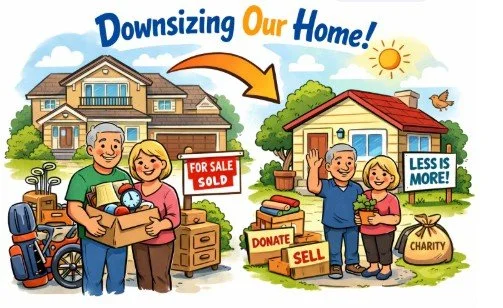
The Reality of Downsizing: What They Don't Tell You About Moving to a Smaller Home
The Freedom of Less: Why Downsizing Might Be Your Best Retirement Decision
Before we retired, we made a decision that would shape everything that followed—we downsized to a bungalow. The house that had been perfect for raising our family now felt like too much—too many rooms to clean, too many stairs to climb, too much yard to maintain.
The decision wasn't easy. That house held every milestone, every memory we'd made as a family. But we realized it had become more burden than blessing, and if we were going to enjoy retirement, we needed to make the move while we still had the energy for it.
Six months into our new bungalow, I can honestly say: this was one of the smartest decisions we ever made. Our monthly expenses dropped significantly, and we've discovered that freedom doesn't come from square footage—it comes from having exactly what you need and nothing you don't.
If you're considering downsizing before retirement, you're not alone. You're making space for what comes next...
We planned it for years. Once the kids were gone and we retired, we'd downsize. Simple, right? We'd be those zen minimalists sipping wine in our clutter-free haven, congratulating ourselves on our brilliant life choices.
Well, three years into our "smaller" home, I'm here to tell you the truth about downsizing—and it's messier, funnier, and way more complicated than those smug lifestyle blogs admit. Spoiler alert: I'm typing this while staring at unpacked boxes from 2021..
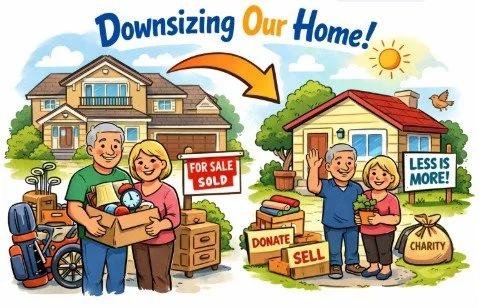
The House We Left Behind
Our family home wasn't a mansion by any stretch. Just under 2,400 square feet with five bedrooms (okay, four real bedrooms and one small room we generously called an office). Two ensuite bathrooms, a main bathroom, and a powder room on the main floor. During COVID, that little office became my fortress of solitude—a place where I could close the door and everyone knew "Mom's working, don't bother her unless someone's bleeding."
My kids were angels about respecting that boundary. Probably because they were terrified of me on conference calls.
But here's what we didn't have for 16 years: a basement bathroom.
Yes, you read that right. We finally installed one just as we were preparing to sell. It was beautiful. I barely got to use it. Such is life.
The Never-Ending Renovation Cycle (AKA My Personal Hell)
We bought our house when it was only two years old. "Oh, you're so lucky!" people would gush. "A new house—nothing to do!"
Laughs in perpetual renovation
Here's my superpower: I have an uncanny ability to buy houses from older women whose decorating tastes peaked somewhere between the Y2K panic and the first iPhone. This means even a "new" house comes pre-vintage. We spent 16 years updating that place, one exhausting, expensive project at a time.
The grand finale? Just before listing the house, we had to:
Rip up the entire kitchen floor (nothing says "fun" like shattered tile at 7 AM)
Move all our cabinets into the living room (ever tried cooking dinner with your kitchen in three rooms? Don't.)
Retile everything while living in chaos
Paint the cabinets (finally, goodbye golden oak!)
Install new stone countertops
Oh, and install that mythical basement bathroom I mentioned
The irony? The house finally looked exactly the way I'd always dreamed—right when we handed the keys to someone else. They probably repainted everything beige within a month.
Buying High, Selling High, and Learning Nothing Apparently
We bought and sold during that insane market when prices were stratospheric but just starting their descent. Yes, we overpaid. Massively. But we also sold high, so it balanced out... kind of... if you don't think about it too hard.
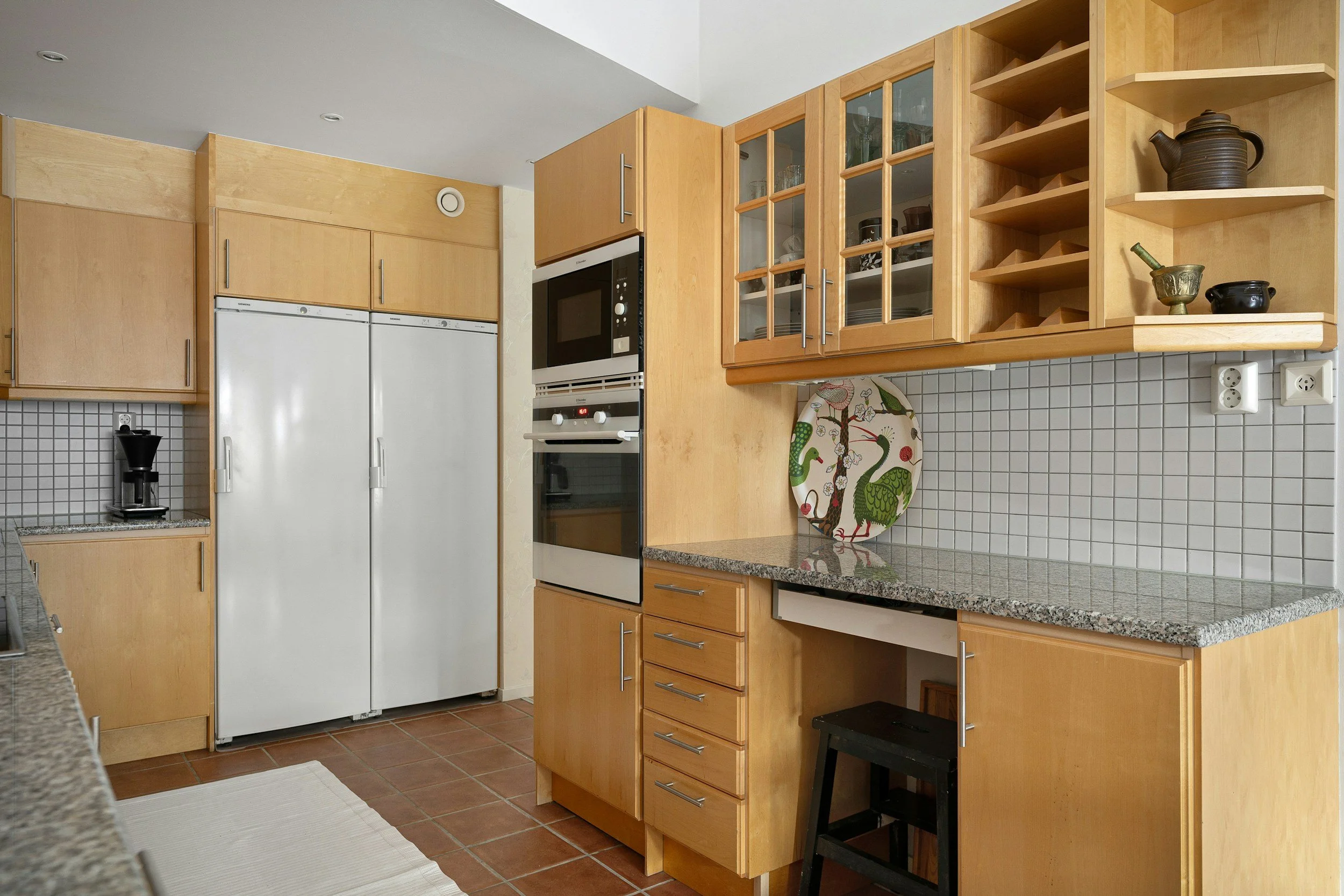
And guess what brilliant move we made next? We bought another new house from another older woman. Her taste? Frozen solid in 1999. I'm talking light oak cabinets - again, and laminate countertops that probably remember Seinfeld's final episode.
Those kitchen cabinets are screaming for paint. Nearly four years in, they're still waiting, sporting their original honey oak finish like a time capsule nobody asked for. But when you're juggling a fence installation, a basement finish, and a new patio, there's only so much time and money to go around.
The cabinets can wait. They've already waited 25 years. What's a few more months? (This is what I tell myself at 2 AM when I can't sleep because those cabinets are haunting me.)
The Three Stages of Purging (And Why You'll Never Actually Finish)
Downsizing means getting rid of stuff. Mountains of stuff. Everests of stuff you forgot you owned. We went through three distinct purge phases:
Phase One: Pre-listing Panic
The frantic scramble to declutter before strangers judge your life choices. Donation bags multiplied like rabbits. I threw out things I'd sworn were "sentimental" just days before.
Phase Two: Moving Day Reckoning
The brutal "WHY DO WE STILL HAVE THIS?" fights with your spouse while knee-deep in packing tape and bubble wrap. More bags to charity. Still somehow ended up with 47 boxes labeled "miscellaneous."
Phase Three: The Eternal Unpacking
Over three years later, we're still opening boxes and experiencing a mix of confusion and horror. "We packed twelve serving platters? For what occasion—the Second Coming?" There are still plenty to go through. I'm convinced those boxes are secretly reproducing in the storage room when we're not looking.

The Plot Twist: Two Houses (Because We're Gluttons for Punishment)
Part of our master plan involved building a summer house on the east coast where I'm from. Because clearly, what we needed while downsizing one house was to manage two properties simultaneously. Genius move, really.
This "simplified" our downsizing strategy in absolutely zero ways:
Shipping "extra" and older furniture to the summer house (translation: the stuff too ugly for the new main house but too guilt-inducing to donate)
Buying new pieces for the main house (there goes the downsizing budget)
Playing a never-ending game of "Which House Does This Belong In?"
Having the slow, dawning realization that we hadn't downsized—we'd just distributed our clutter across two postal codes
Brilliant. Just brilliant.
The Time Crunch No One Warns You About (Thanks for Nothing, HGTV)
Here's what those glossy downsizing blogs conveniently forget to mention: going back to work changes everything. When we planned this downsizing adventure, we envisioned leisurely Saturday mornings organizing closets, thoughtfully curating our belongings while sipping artisanal coffee and discussing which throw pillows spark joy.
Reality? Work resumed. Life got busy. Weekends disappeared into errands and exhaustion. Those boxes? Still sitting there, judging me every time I walk past. The house projects? Happening at the speed of continental drift.
Turns out Marie Kondo doesn't make house calls, and nobody warned me that downsizing with a full-time job is basically a part-time job you're not getting paid for.
Practical Tips They Don't Put in the Pinterest Guides
Alright, enough therapy. Here's what actually helps when you're drowning in boxes and outdated cabinetry:
1. The One-Year Rule is a Lie
You know that advice: "If you haven't used it in a year, donate it"? Adorable. Here's the truth: you'll open a box three years later, find your grandmother's casserole dish, and cry because you thought you'd donated it. Give yourself permission to keep some stuff "just because." We're downsizing, not entering a monastery.
2. Take Before Photos (For Your Sanity)
Document your old house before you renovate it to perfection and then leave. Why? Because in your new place, when you're staring at those 1999 cabinets at 11 PM, you can look back and remember: "Oh right, we survived worse." It's oddly comforting.
3. The Box Labeling System Everyone Ignores
Label boxes by room AND by priority. "Kitchen—Daily Use" vs. "Kitchen—Serve-ware for That Dinner Party We'll Never Host." Three years later, you'll know exactly which boxes can stay sealed forever. (It's the second category. It's always the second category.)
4. Budget 50% More Than You Think
Whatever you think renovations will cost, multiply by 1.5. Minimum. Those kitchen cabinets you thought you'd paint for $200? Try $800 once you factor in primer, good paint, hardware, your time, and the inevitable second coat because the first one looked "blotchy."
5. Make Friends with Your Local Donation Center
You'll be there weekly. Monthly if you're lazy like me. The workers will know your name. Embrace it. You're keeping someone employed with your clutter.
6. Don't Renovate Everything Before You Sell
This one hurts, but it's true. We installed that beautiful basement bathroom right before we left. The new owners probably think we're idiots (they're right). Save the big projects for YOUR house, not the next person's.
7. Give Yourself Five Years, Not Two
Everyone says downsizing takes two years to "settle in." They're lying. Give yourself five. Maybe seven. The boxes will still be there. The cabinets will still need painting. That's just life now.
8. The Storage Unit is Not a Solution
It's a very expensive way to avoid making decisions. If you're paying monthly to store things you haven't thought about in a year, just donate them. Rip the bandaid off. Your bank account will thank you.
9. One Project at a Time (Even If It Kills You)
Trying to do the fence, the basement, AND the patio simultaneously will end in tears and marital strife. Pick one. Finish it. Then start the next. Revolutionary concept, I know.
10. Lower Your Standards (Just a Little)
That Instagram-perfect home? Not happening while you're working full-time and still unpacking. And that's okay. A lived-in house beats a perfect house every single time. Those honey oak cabinets can wait another six months. Or a year. Who's counting?
What I've Learned So Far (Besides Humility)
Three-plus years into downsizing, here's my brutally honest takeaway:
Downsizing isn't a one-time event—it's a lifestyle you didn't ask for
Your timeline will expand—double it, then add six months for good measure
Renovations follow you—like a really persistent ex, they never truly leave
Perfect timing doesn't exist—we still haven't painted those damn cabinets
It's worth it anyway—even imperfect, incomplete, and slightly chaotic
Our house isn't magazine-ready. We're still opening boxes marked "2021" (I'm afraid to know what's in them). The kitchen cabinets are still sporting their Y2K aesthetic. There's a fence that needs staining, a basement that's half-finished, and approximately 47 throw pillows that I swear I purged but somehow reappeared.
But you know what? We're building our life here, one unfinished project at a time, one mysterious box at a time, one "we'll get to it eventually" at a time.
And someday—probably right before we sell again and move into an even smaller place with even more outdated fixtures—those cabinets will finally get painted.
I'm giving it another two years. Maybe three. Definitely by 2030.

Embracing Movement After 50: A Personal Journey and Practical Guide
Embracing Movement After 50
Age is not a limitation—it's an invitation to move with intention, strength, and joy. After 50, your body craves movement that honours where you've been while building where you're going.
Whether you're rediscovering fitness or maintaining lifelong habits, this is your time to embrace exercise that energizes rather than exhausts, strengthens rather than strains, and celebrates what your body can do today.
From gentle stretching and walking to strength training and balance work, movement after 50 is about sustainability, not intensity. It's about waking up feeling capable, staying independent, and moving through life with confidence and vitality.
Your body has carried you this far—let's keep it moving forward.
My younger self was one of the lucky ones — thin, active, and seemingly able to eat what I liked without gaining weight. In my 20s, I was a gym rat—the kind who'd spend hours there happily moving between stretching, cardio, and weights. I wasn't bodybuilder-level, but I was strong and I had abs I was proud of. But life happens; full-time work, raising children, evenings spent doing courses instead of hitting the gym. Exercise became something I had to fit in, rather than something I simply loved.
The weight came off quickly after my first child, but after my second, those last few pounds stubbornly remained. In my 40s I noticed the weight creeping up. Then I turned 50 … and suddenly weight seemed to want to be my new best friend. I saw changes in areas I never worried about in my 20s and 30s. I tried everything: Noom, a nutritionist, Weight Watchers. They all worked — if I followed the plan perfectly. The problem? I never truly learned how not to eat whatever I wanted. The relationship I once had with food, had fundamentally changed.
Now, keeping fit in my 50s feels vastly more challenging. But it is possible. With a few smart updates to how I approach movement and health, I’m discovering a way of staying active that honours both the body I have now and the one I used to have.
Why Moving Matters (Especially After 50)
Good news: becoming more active isn’t just about chasing the "old you" — it’s about finding the best you at this stage of life.
Here's what I've learned from all the reading I've done: movement matters—more than I realized. Staying active after 50 isn't just about looking good or maintaining weight. It genuinely helps us live longer and feel better. Things like brisk walking, cycling, or jogging support heart health and longevity. Strength training becomes crucial because it fights the natural muscle loss that accelerates as we age, protects our bones, and helps with balance. And the benefits go beyond the physical. I've noticed that when I'm moving regularly, my mood is better, my thinking is clearer, and I just feel more capable of handling whatever life throws at me. So yes — even if your younger self was lean and active, the game changes in your 50s. And that’s okay. You’re not just maintaining, you’re adapting.
What’s Changed (And What to Do Differently)
From my own experience, here are some of the shifts I’ve noticed and the adjustments that have helped.
Slower metabolism & changing body composition
It feels as though the body that easily drifted along in previous decades now resists. Here's what I've noticed:
I'm losing muscle without even trying. Strength that came naturally before now requires intention and effort to maintain.
Weight gravitates to different spots. My 20s and 30s blessed me with easy abs and arms I never thought about. My 50s? Fat accumulates around my back, hips, and midsection in ways that feel entirely new.
Everything metabolically shifted after menopause. My body's relationship with food and energy changed fundamentally. The rules are different now.
What to do:
Add strength training 2–3 times a week. The goal isn't a bodybuilder physique—it's about feeling strong and capable in daily activities.
Give more attention to protein intake, quality sleep, and nutrient-dense foods. Recovery becomes increasingly important, and nutrition directly impacts energy and well-being.
Let go of calorie-counting mentality. Shift focus to building strength and sustaining consistent movement. This reframing creates a healthier, more sustainable approach.
Movement must evolve
The body at 25 can handle almost anything. At 50, joints, recovery time, and energy levels require a more thoughtful approach.
Aerobic exercise remains essential. Brisk walking, jogging, or cycling all support cardiovascular health and help reduce disease risk.
Strength and resistance work becomes more crucial with each passing year—it's what maintains muscle, protects bones, and keeps the body functional.
Gentle, low-intensity movement matters too, especially for anyone starting fresh or easing back into fitness after a break.
What to do:
Set a realistic weekly goal: aim for 150 minutes of moderate aerobic activity and 2 strength sessions per week.
Choose exercises that protect joints, enhance balance, and reduce injury risk (e.g., bodyweight squats, resistance bands, walking uphill, Pilates).
Make it regular — even short bursts of movement are meaningful.
Mindset shift: from “working out” to “moving for life”
In my 20s I went to the gym to maintain weight or counterbalance a slice of cake. In my 50s it’s more about longevity, strength, and health.
What to do:
Reframe exercise as a form of self-care and prevention—not punishment.
Recognize that the body you have today is different — and deserving of its own best practice.
Embrace movement you enjoy (friend walks, biking, dance, pickle ball) so consistency is more likely.
Tips that helped me:
• Consistency over intensity: Some days I simply walk; other days I lift (or plan to).
• Build habit, not perfection: Some weeks I work out consistently. Other days I veg and watch TV. That’s life.
• Recovery matters: Good sleep, mobility work, and rest days help me feel ready.
• Nutrition supports everything: I aim to eat for health and energy, not just weight.
• Enjoyment = longevity: If it feels like a chore, I’m less likely to stick with it. I pick movement I like.
Final Thoughts
Turning 50 brought with it a realization: staying fit is no longer simply about being lean or chasing curves. It’s about sustaining mobility, enjoying life, preventing decline, and feeling strong in this version of me.
My younger self might have scoffed at a 30-minute walk or thought resistance bands were a substitute. But my 50-something self knows this: movement is everything. Strength matters. The body that supports my kids, career, hobbies, friendships is worth investing in.
If you’re there too — navigating the changes, noticing the shifts, wondering “what now?” — know this: you’re not starting late. You’re simply starting right. Be kind to yourself. Celebrate progress, not perfection. And keep moving forward.
Consistency is the hardest part for me! What are some of your best mental trick or routine secret for staying motivated and getting out the door on a day you just don't feel like it?
Here are some of the websites I have used for staying fit:
• Hoag Foundation. https://www.hoag.org/aspire/the-benefits-of-staying-fit after-50/ Hoag
• WebMD. https://www.webmd.com/healthy-aging/what-to-know-about-running after-fifty WebMD
• AARP. https://www.aarp.org/pri/topics/health/prevention-wellness/physical activity-exercise-benefits/ AARP
• Stanford Longevity Center. https://longevity.stanford.edu/lifestyle/2024/07/02/recommended-exercises for-adults-50/ longevity.stanford.edu
Feel free to use these as starting points to build your own plan, adjust as you learn what your body responds to, and enjoy the journey of movement after 50!
What have you done to stay active and fit in your 50’s

Women exercising