
Makeup Tips for Mature Skin: Because We're Not Trying to Look 25
Makeup tips for Mature skin
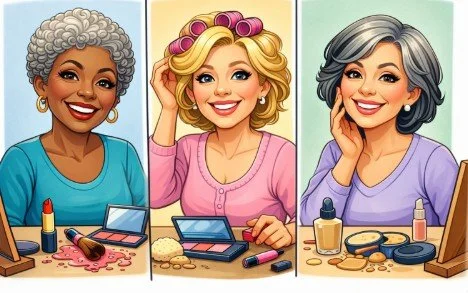
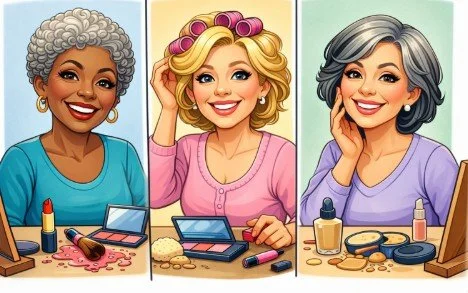
There’s a special kind of bravery that comes with putting on makeup after 50. Your eyes water for no reason, your hands don’t quite listen anymore, and suddenly eyeliner feels like an extreme sport. Some days end with mascara on your cheekbones and foundation settling into places you didn’t know existed. And then there are the good days—the ones where you finish, step back, and think, Well hello… there I am. This is the reality of makeup in midlife: a little chaos, a lot of humor, and moments of confidence that feel hard-won and well deserved.
A brutally honest guide from someone who peaked at mascara application in 1987
Look, I'm going to level with you right from the jump: I have absolutely no business writing a makeup guide. None. Zero. I am the human equivalent of a "Pinterest Fail" meme when it comes to cosmetics.
But here's the thing—I'm pretty sure there are thousands of us out here, wandering through Sephora like confused tourists in a foreign country, pretending we understand what "setting spray" is and nodding knowingly when the 19-year-old sales associate mentions "baking." (Spoiler alert: she's not talking about cookies, and I'm still disappointed about it.)
Full disclosure: My makeup skills peaked somewhere around 1987 when I mastered the art of applying Maybelline Great Lash mascara without poking myself in the eye. It's been downhill ever since.
The Problem With Modern Makeup (Or: Why Is Everything So Complicated Now?)
Remember when makeup was simple? You had foundation (one shade: "sort of beige"), lipstick (red or pink), and if you were feeling fancy, some blue eyeshadow. Done. You looked like every other woman in America, and that was fine.
Now? NOW we have primers and color correctors and highlighters and bronzers and contour kits and "strobing" and about 47 other things I can't even pronounce. When did makeup application become a full-time job requiring a degree in fine arts?
And can we talk about how our skin has completely betrayed us? You try to apply a little eyeshadow and your eyelid is like "lol, remember when I used to be smooth and stay in one place? Yeah, those days are OVER, sister." Everything slides, creases, settles into lines you didn't even know existed. It's like your face is actively working against you.
Contour: A Mystery Wrapped in an Enigma, Smeared on Your Face
Okay, seriously, what the hell is contour? I've watched approximately 4,000 YouTube videos, and I still don't get it. Apparently, you're supposed to paint dark stripes on your face to create "shadows" and then paint light stripes to create "highlights," and somehow this is supposed to give you cheekbones like a supermodel.
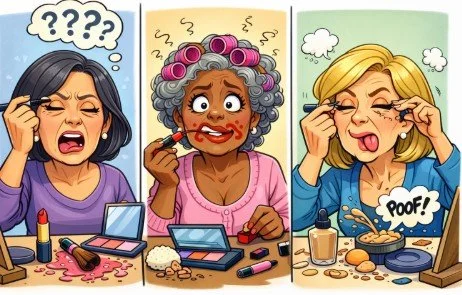
You know what actually happens when we try this? We look like we got in a fight with a mud puddle and forgot to wash half our face. The 23-year-old beauty influencers make it look so easy. "Just blend!" they chirp, waving their makeup brushes like magic wands.
Bruh. BRUH. My skin doesn't blend. It absorbs makeup unevenly, settles into every crevice, and then slides off my face by 2 PM like it's trying to escape.
Hot take: Maybe—and hear me out here—maybe we don't NEED contour. Maybe our faces are perfectly fine the way they are. Maybe the only people who need contour are runway models and people in witness protection trying to change their appearance
The Color Conundrum (Or: Everything Looks the Same Until You Get Home)
Can we discuss the absolute nightmare that is choosing makeup colors? There are approximately 847 shades of "nude" lipstick, and I swear on everything holy, they ALL look identical in the tube. Then you get home, apply it, and you've somehow purchased either "corpse chic" or "I ate a highlighter and it's not sitting well with me."
And don't even get me started on foundation matching. "What's your undertone?" the sales lady asks. I don't know, Carol, I didn't realize my skin had TONES. I thought it just had... color? Apparently, I'm supposed to know if I'm "warm," "cool," or "neutral." I'm usually just "tired."
My Completely Unqualified Color Advice (Take at Your Own Risk):
Eyeshadow: Is blue eyeshadow back? Is it still out? Does anyone actually know? I've decided to stick with browns and taupes because they're basically impossible to screw up catastrophically. They just make you look slightly sleepy, which at our age is pretty much baseline anyway.
Lipstick: Here's my foolproof test: If you look in the mirror and your first thought is "that's... a choice," it's too bright. If you think "did someone die?" it's too dark. Aim for somewhere between "I'm wearing lipstick" and "am I wearing lipstick?" That's the sweet spot.
Blush (yes, we're calling it blush now, not rouge): Apply it. Look in the mirror. Remove half of it. Look again. Remove half of what's left. NOW you're getting close. Trust me on this—what looks "barely there" in your bathroom mirror will photograph as "possibly a clown" in natural light.
I once bought a foundation described as "radiant beige." Turned out "radiant" was code for "orange." I looked like I'd been using Trump's personal makeup artist. My husband asked if I was feeling okay. I was not.
Skincare: The Thing I Should've Started Caring About in 1995
Everyone's obsessed with skincare routines now. Ten-step Korean skincare! Retinol! Vitamin C serums! Hyaluronic acid! Peptides! It's like someone raided a chemistry lab and decided to market it to middle-aged women as "self-care."
My skincare routine for the first 40 years of my life was basically some sort of cleaners. Code for “Whatever is on sale”. Give me some sort of props for at least moisturizing daily. Woohoo!!!
Now I'm supposed to have a morning routine and an evening routine and something called "actives" that I'm meant to layer in a specific order determined by... molecular weight? I don't know, I wasn't paying attention during chemistry class. I was too busy perfecting my blue eyeshadow application.
The truth: You know what would've helped my skin? Sunscreen. Every day. Starting in 1982. But did I do that? Of course not. I was too busy slathering myself in baby oil and lying in the sun like a rotisserie chicken. Past me was an idiot.
The Great Eyelid Rebellion of Our 50s
Let's address the elephant in the room, shall we? Our eyelids have officially declared independence from our face. They don't stay where we put them. They fold in unexpected directions. They crease in new and creative ways every single day.
Trying to apply eyeliner is like trying to draw a straight line on a water bed. During an earthquake. While someone's yelling at you about your car's extended warranty.
And eyeshadow? Forget about it. You carefully apply a nice neutral shade, look down for THREE SECONDS, look back up, and it's migrated into every single crease you have. You've gone from "subtle and sophisticated" to "did she fall asleep in her makeup from 1985?" in the time it takes to blink.
Things that actually help (discovered through extensive trial, error, and low-key crying in my bathroom):
• Primer: I don't understand what it does, but it does SOMETHING. It's like giving your makeup a fighting chance before it inevitably slides off your face anyway.
• Cream products: Powder is the enemy. It settles into every line on your face like it's trying to highlight your entire life story. Cream products at least have the decency to betray you more subtly.
• A light hand: Whatever you think looks good, use half that amount. Then use half again. You're welcome.
YouTube Tutorials: A Journey Into Despair
I've watched so many makeup tutorials. SO MANY. Each one hosted by a gorgeous 22-year-old with perfect skin, perfect lighting, and the steady hands of a neurosurgeon.
"This is super easy!" they say, as they effortlessly create a flawless cat eye in 2.3 seconds. "Anyone can do this!"
No. No, we cannot. Their skin is still cooperating with them. Their eyelids haven't yet learned about gravity. They can actually SEE their entire eyelid when they close their eyes. They're living in a completely different reality.
Also, why do they all do their makeup in a ring light bright enough to guide aircraft? Of course everything looks good in lighting that intense. I could probably contour with mud in that lighting and still look decent.
Once watched a tutorial on "how to make your eyes look bigger." Spoiler alert: the only way to make my eyes look bigger at this point is photoshop or surgery. The makeup tips were lies. All lies.
What I've Actually Figured Out (Barely)
After approximately 35 years of mediocre to terrible makeup application, here's what I've learned:
1. Lighting is everything, and it's all lying to you. Your bathroom mirror is a liar. That Target dressing room mirror? Also a liar. The only truth is natural sunlight, and even then, it's probably being passive-aggressive.
2. Moisturizer > Everything else. Seriously. You could skip every other step and just moisturize, and you'd probably look better than if you spent 45 minutes applying 17 different products to dry, angry skin.
3. Less is actually more. I know, I KNOW, every tutorial says this and I ignored it for years. Turns out they were right. Shocking.
4. Your eyebrows are more important than you think. They frame your entire face. Mine have been gradually disappearing since 2010 thanks to waxing according to the girl now threading my eyebrows. Some days they're sisters. Most days they're distant cousins who don't talk at family gatherings.
5. Mascara is still magical. Even when everything else goes wrong (and it will), mascara can make you look like you got at least four hours of sleep. Which is basically the best we can hope for at this point.
Oh, I did try false eyelashes. Briefly.
Nothing quite humbles you like someone squinting at your face and asking, “Uh… what’s on your eye?”
Apparently, false lashes are not a “set it and forget it” situation. They migrate. Quietly. Especially when you rub your eyes. By the end of the day, I looked less glam and more confused craft project.
What We Actually Need (And I'm Talking to the Beauty Industry Here)
Forget products for "mature skin" that are just overpriced versions of regular products in fancier packaging. Here's what we ACTUALLY need:
• Foundation that doesn't settle into every line like it's trying to map out our entire life journey
• Eyeliner that accounts for the fact that our eyelids are no longer smooth surfaces
• Lipstick that doesn't bleed into the fine lines around our mouth (you know, the ones that mysteriously appeared overnight)
• Eyeshadow that STAYS PUT for more than 12 minutes
• A color-matching system that doesn't require a degree in color theory
• Tutorials from people who also have no idea what they're doing but are willing to try anyway
Real talk: Some days you'll get it right. Most days you'll look like you applied your makeup in a moving vehicle during a tornado. Both are perfectly acceptable outcomes.
My Current "Routine" (Heavy Air Quotes)
On days when I actually wear makeup (which, let's be honest, is becoming less frequent because WHO HAS THE TIME):
Morning: Moisturizer with SPF. This is non-negotiable. Past me didn't use sunscreen, and present me is VERY ANGRY about that decision.
If I'm leaving the house and want to pretend I have my life together:
• Tinted moisturizer (because "foundation" sounds like too much commitment)
• Concealer under my eyes (because the bags are now permanent residents)
• Blush (applied, then immediately regretted and half-removed)
• Eyebrow pencil (today we're attempting "sisters," but we'll probably land on "vague acquaintances")
• Mascara (the one thing I can do without a tutorial)
• Lipstick in some shade of "is this color or is this just fancy chapstick?"
Total time: 10 minutes. Results: somewhere between "she tried" and "is she okay?"
The Truth Nobody Wants to Hear
Here it is, the big secret: nobody actually knows what they're doing. Those beauty influencers? They're good at makeup, sure, but they're working with 25-year-old faces. That's easy mode. We're playing on expert level with equipment that's actively working against us.
And you know what else? Most people aren't looking at you that closely anyway. They're too busy worrying about their own disappearing eyebrows and whether they remembered to blend their own makeup.
So yeah, I still don't know what contour is. I can't tell you which serum goes on first. I don't understand why there are 47 different types of mascara when they all basically do the same thing.
But I'm showing up. With or without makeup. With or without any clue what I'm doing. And honestly? That's enough.
"The goal isn't perfection. The goal isn't to look 25. The goal is to look in the mirror and think 'yeah, okay, I can work with this' and then get on with your day."
In Conclusion (Because Even My Rambling Must End Eventually)
Am I qualified to give makeup advice? Absolutely not. Do I understand contouring? Still no. Have I figured out my undertones? Not even a little bit.
But I've made peace with being bad at this. I've accepted that my makeup skills peaked in the late 80s and it's been a slow decline ever since. I've embraced the fact that "good enough" is actually good enough.
And if you're like me—still confused by modern makeup, still not sure if rouge is called blush now, still Googling "how to apply eyeshadow" like you're going to magically understand it this time—you're not alone.
We're out here. We're trying. We're failing. We're showing up anyway.
And honestly? That's the most beautiful thing of all.
(That was too sincere. Let me end on brand: My face and I have reached an understanding—I'll stop trying to dramatically transform it with techniques I don't understand, and it'll stop moving around so much when I'm trying to put on mascara. We're still negotiating the eyebrow situation.)
P.S. If anyone ever figures out contour and can explain it to me using only words of one syllable and possibly interpretive dance, I'm all ears.
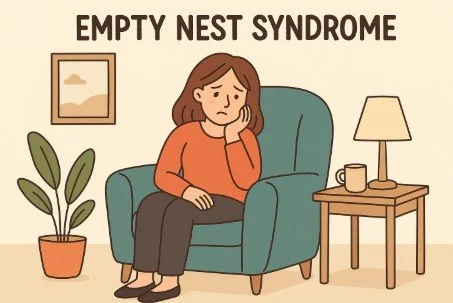
Empty Nest Syndrome
Empty Nest Syndrome: When the House Gets Quiet (Too Quiet)
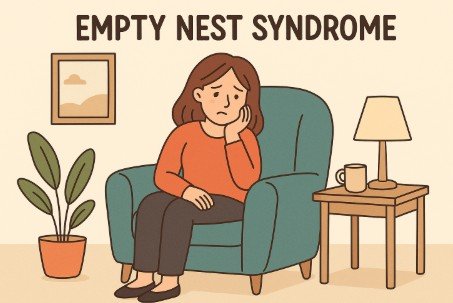
No one really prepares you for the moment when the house goes from loud, chaotic, and full of life… to eerily quiet. One minute you’re stepping over shoes, reminding someone (again) to unload the dishwasher, and negotiating curfews. The next? You’re standing in the kitchen wondering why it’s so clean — and why that feels strangely unsettling.
Empty nest syndrome isn’t just missing your kids; it’s adjusting to a new version of yourself. Your role shifts overnight, and suddenly you’re left asking, “So… now what?” You’re proud, sad, relieved, nostalgic, and lonely — sometimes all before lunch. And yes, it’s completely normal to feel all of it at once.
The good news? This quieter chapter isn’t the end of your story — it’s a plot twist. One that gives you space to reconnect, rediscover, and maybe even enjoy not sharing the bathroom. Eventually, the silence gets less heavy… and starts to feel like possibility.
So Your Kids Left Home. Now What?
A brutally honest guide to Empty Nest Syndrome (spoiler: you’ll survive… probably with snacks and sarcasm)
Okay friend, listen. Nobody warned us about this part. Everyone preps you for sleepless newborn nights, the terrible twos, and the full-blown psychological thriller that is puberty. But Empty Nest Syndrome? Nope. That little plot twist just sneaks up like a cat knocking something off the counter while making eye contact.
One minute you’re whining about Mount Laundry and a grocery bill that rivals the GDP of a small nation. The next? Silence. Glorious. Unsettling. “Why is it so quiet and why do I suddenly feel weird about it?” silence.
Honestly, for a long time it didn’t even feel like my kids had moved out. It was more like a very long, very confusing game of musical chairs.
My stepdaughter had been living with her partner, so technically she was gone… until life happened. The relationship ended, the job disappeared, and boom—she was back home. Surprise!
My oldest stayed home for her first year of university thanks to lovely little COVID, then went away to school for four years.
My youngest went away for school too, quit her program, worked her summer job, and stayed with her boyfriend’s parents. Then she went back to school and moved into a student apartment.
So really… had anyone actually moved out? Or were they just aggressively rotating locations?
Then my daughter finished school and moved in with her boyfriend. And that—that was the moment. The “oh crap” moment. The realization that this wasn’t temporary. My kids weren’t just visiting adulthood; they were unpacking there.
That’s when it hit me: my kids are growing up. They’re building lives, making choices, and moving forward. And while I’m incredibly proud… I’m also standing in a quiet house wondering who drank all the milk when nobody’s even home.
So yes, the nest is emptier. But here’s the thing no one tells you: you’re still here. You survived diapers, drama, and Door-Slamming Teenage Years. You can survive this too.
And hey—at least now the snacks you buy actually last longer than 24 hours. 💁♀️
The Five Stages of Empty Nest Grief (That Nobody Talks About)
Stage 1: Denial
“This is AMAZING! I can finally watch my shows without someone yelling ‘What’s for dinner?’ every five minutes!”
You deep-clean their room like you’re auditioning for a home makeover show. You reorganize the pantry. You alphabetize spices. You convince yourself this—this right here—is the freedom you’ve been waiting for.
Except… not really.
Like I mentioned earlier, it honestly didn’t even feel like my kids had moved out. It was more of a “they’re kind of gone but also kind of not” situation. My stepdaughter is still with us, so technically we’re not empty nesters at all. We’re more like empty-nest-curious.
We’re standing on the edge of it, peeking over, saying, “Oh wow, that looks nice,” while also whispering, “But please don’t move too far away.” Because yes, we’re looking forward to being empty nesters… eventually. The quiet sounds lovely. The freedom is tempting.
But do we still want our kids close? Around? Dropping by? Eating our food? Absolutely. Well—at least I do. Let’s be honest, I want the best of both worlds: independence and random visits where they magically appear when the fridge is full.
Denial, after all, isn’t just pretending they’re gone. It’s pretending you’re totally ready for it when you’re very much not. And that’s okay. 💕
Stage 2: Bargaining
This is where the texting starts. And by starts, I mean escalates rapidly.
“Just checking in!”
“How’s the weather there?”
“Did you eat today?”
You are basically one emotionally charged decision away from tracking their location like they’re still 16 and you’re totally normal about it.
Real talk: if you’ve texted your kid three times before noon to confirm they’ve had breakfast, congratulations—you are deep in the bargaining stage. It’s fine. This is a judgment-free zone. We’ve all been there.
Sometimes they text me back right away, which gives me false hope and dopamine. Other times… it takes a few days. DAYS. I try to stay calm, but let’s be honest—I’m mentally drafting my will by hour 36.
Now, I will admit: I still pay for the cell phones of the two youngest. And yes, I absolutely consider that leverage. Am I proud? No. Will I use it? Also no. But do I know it exists? Absolutely.
In six months, though, that safety net disappears. My oldest will be responsible for her own phone bill. Her own bills. I honestly don’t know what I’ll have to hold over her head to return my calls. Emotional guilt? Home-cooked meals? “Accidentally” etransfer-ing her money and reminding her I exist?
That step—when she takes over her phone and car insurance—that’s really the beginning of full-blown adulthood. Sure, some of my bills will be lower (and I am looking forward to that, let’s be clear). But emotionally? That’s the moment where bargaining officially stops working.
So here I am, enjoying slightly fewer bills, slightly more silence, and realizing I’m running out of things to negotiate with.
Anyway… onward to Stage 3. 😅
Stage 3: The Identity Crisis
And now we arrive at the big, slightly uncomfortable question:
Who are you when you’re no longer parenting someone 24/7?
For years, “Mom” or “Dad” wasn’t just a title—it was your entire personality. You didn’t have hobbies, you had schedules. You didn’t have interests, you had carpools. Now suddenly the lunches are unpacked, the permission slips are gone, and you’re standing there thinking… Wait. Is there still a person under all this?
Apparently, yes. But she’s a little rusty and hasn’t been asked what she wants in years.
Also, side note: my kids didn’t even call us the same thing over the years. After “Mommy,” my oldest decided to upgrade me to Mother.
MOTHER.
I don’t know what image that word brings up for you, but for me it was cold hallways, distant parents, and children being shipped off to boarding school while their parents politely forgot their names. I hated it. My daughter, however, thought it sounded very grown-up and sophisticated. Meanwhile, I was internally screaming, “I AM STILL WARM AND AFFECTIONATE, THANK YOU.”
Thankfully, I’ve now been downgraded—sorry, upgraded—to Mum. Sweet, familiar, comforting. Huge relief. My identity is no longer “emotionally distant Victorian parent.” Progress.
My youngest, meanwhile, went through a phase of learning German in her teens, which resulted in some… creative naming. Her dad is still “Vader” (yes, like Darth Vader, and honestly that tracks. He is a huge Star Wars fan). But at least I stayed Mom. I survived the linguistic experiment.
I know I’ll always be Mum or Mom—and I’m grateful for that. But I won’t lie… I loved being Mommy. That version of me felt soft, needed, and very much at the center of their world.
So yeah. Stage 3 is realizing you’re still you, just without the constant chaos. And maybe—just maybe—learning how to hold onto who you were, while figuring out who you’re becoming next. 💕
What Nobody Tells You (But I Will)
The hardest part isn't missing them—it's missing who *you* were when they needed you. Parenthood gave you purpose on a silver platter. Now? You've got to figure out your purpose yourself. How utterly inconvenient.
"I spent 18 years making sure someone else was okay. Now I have to figure out if I'm okay? This wasn't in the parenting manual."
But here's the thing they don't show in the Hallmark movies: this is actually your chance to become interesting again. Remember hobbies? Remember having thoughts that didn't revolve around school schedules and what's for dinner?
The Ridiculous Things You'll Do
You'll keep making too much pasta. You'll set the table for four instead of two. You'll hear a noise at 11 PM and think "they're home!" before remembering they live 500 miles away now.
You'll also do weirder things, like:
• Walking past their empty room and feeling like you're in a museum
• Getting unreasonably emotional at Walmart (or browsing Amazon) in the back-to-school section
• Considering getting a dog, a cat, or possibly a llama to fill the void
• Stalking their social media like you're training for the FBI
Pro tip: The dog will love you unconditionally and never roll their eyes at your jokes. Just saying.
The Plot Twist
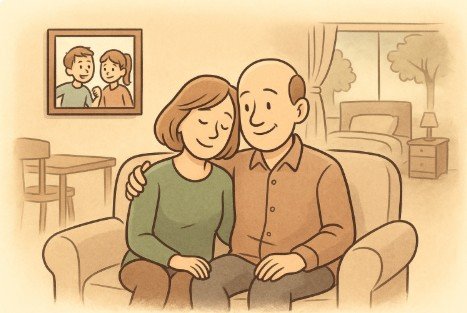
Eventually—and I promise this happens—you'll realize something strange. You kind of... like this? The quiet. The spontaneity. The ability to eat cereal for dinner without judgment. The relationship you have with your partner (or yourself, or your friends) without the constant background noise of parenting.
Your kids will call. They'll ask for advice. They'll need you in different ways. And you'll be there, because that part never changes.
But you'll also be living your own life. Finally. Again. Whatever.
So What Now?
Give yourself permission to feel weird about this. Give yourself permission to miss them and also enjoy sleeping past 7 AM. Give yourself permission to be more than just someone's parent.
Because here's the truth: you did your job. You raised a human capable of leaving. That was literally the entire point. Congratulations, you succeeded. Now the next chapter is about figuring out what success looks like for you.
No pressure or anything.
And if all else fails, there's always wine and group therapy. Preferably in that order.