
Navigating distant family holidays as parents age
When the Holidays Highlight the Distance
The holiday season has a way of highlighting how families evolve over time. My parents are aging, and the distance between us feels more significant with each passing year. I'm settled 2,000 kilometers away in another province, while my brother works an offshore rotation—three weeks on the rigs, three weeks off. This Christmas, they'll be spending the holidays alone.
When I talk to them, they reassure me they're fine, that they've grown accustomed to our absence. But I hear what they don't say. I know it's difficult, especially when they see other family members surrounded by children and grandchildren while their own family connects from a distance.
A memory surfaces: my grandmother at Christmas, watching the door, singing softly about wishing it would open to reveal my uncle and his family of six who lived far away. Now I realize my parents must feel exactly the same way.
As I watch this unfold, I can't help but think about my own future. One day, my children will have their own lives, their own distances to manage. The hardest part is accepting that family life evolves, and the crowded, chaotic gatherings of childhood may not be sustainable forever. But that doesn't mean the love diminishes—it just finds new expressions.

family at Christmas with members on laptop
The holiday season has a way of highlighting how families evolve over time. My parents are aging, and the distance between us feels more significant with each passing year. I'm settled 2,000 kilometers away in another province, while my brother works an offshore rotation—three weeks on the rigs, three weeks off. This Christmas, they'll be spending the holidays alone. Between flight costs for my family and my brother's work schedule, neither of us can make it home.
When I talk to them, they reassure me they're fine, that they've grown accustomed to our absence. But I hear what they don't say. I know it's difficult, especially when they see other family members surrounded by children and grandchildren while their own family connects from a distance.
The guilt weighs heavily on both sides. I struggle to balance creating meaningful holidays for my own family while carrying the knowledge that my parents are alone. Meanwhile, my brother and I are navigating new territory ourselves—this year, for the first time, I suggested we stop exchanging gifts for our kids. They're older now, more independent, and the gift exchange has started to feel like a transaction rather than something meaningful. But without that tradition, how do we show we're thinking of each other during the holidays?
I find myself unsure how to navigate this new phase—with aging parents on one side and grown children on the other.
A memory surfaces: my grandmother at Christmas, watching the door, sighing softly about wishing it would open to reveal my uncle and his family of six who lived far away. Now I realize my parents must feel exactly the same way.
My brother is planning a visit before his next rotation, but it'll be three weeks before Christmas. Close, but not quite the same. Still, you adapt. You find ways forward.
As I watch this unfold, I can't help but think about my own future. One day, my children will have their own lives, their own distances to manage. When that time comes, I'll need strategies for coping with holidays that look nothing like the crowded, noisy gatherings I remember from childhood—tables full of grandparents, aunts, uncles, and cousins, all the beautiful chaos of family together in one place.
Here are some practical suggestions for managing these family transitions during the holidays:
Rethink When You Celebrate The calendar date matters less than being together. Consider celebrating Christmas in early January, late November, or whenever schedules align. Creating your own "family Christmas" on a different day can feel just as special and removes the pressure of impossible logistics.
Embrace Technology Meaningfully Schedule video calls during key moments—opening gifts, preparing meals, or just sharing coffee. Some families set up tablets at the dinner table so distant members can "join" the meal. It's not the same as being there, but it creates connection beyond a quick phone call.
Create New Traditions That Span Distance Watch the same movie at the same time while on a call. Send care packages that arrive on Christmas Eve with instructions to open together over video. Start a shared digital photo album where everyone posts holiday moments throughout the season. These rituals acknowledge the distance while building something meaningful across it.
Plan Rotating Gatherings If annual visits aren't feasible, commit to gathering every two or three years. Knowing there's a plan—even if it's far out—gives everyone something to anticipate and makes the in-between years feel less permanent.
Shift Gift-Giving Focus Instead of exchanging gifts between siblings, pool resources for your parents—perhaps funding a house cleaning service, meal delivery, or an experience they'd enjoy. For kids, consider donating to a charity in each other's names or doing a family gift exchange game when you do gather.
Send Presence, Not Just Presents Mail handwritten letters, voice recordings, or photo books that arrive before the holidays. These tangible reminders that someone took time to create something personal can mean more than store-bought gifts.
Check In More Throughout the Year Regular contact during ordinary months can ease holiday guilt. A Tuesday afternoon video call in March might matter more than you think, making the holidays feel less like the only time connection happens.
Accept the Grief Acknowledge that this transition involves loss—loss of traditions, of the family structure you once knew. It's okay to feel sad about what's changing while also embracing what's ahead. Give yourself and your parents permission to miss the old days without guilt.
Create Micro-Moments Even if you can't be there Christmas Day, could you manage a long weekend visit in December? Sometimes a few days together earlier in the season, without the pressure of "the perfect Christmas," can feel more relaxed and meaningful.
Start Conversations Now Talk openly with your parents and siblings about what matters most to everyone. You might discover your parents would prefer a summer visit when the weather's better over a stressful December trip you can barely afford. Their priorities might surprise you.
The hardest part is accepting that family life evolves, and the crowded, chaotic gatherings of your childhood may not be sustainable forever. But that doesn't mean the love diminishes—it just finds new expressions.

Finding and Nurturing Friendships After 50: A New Chapter in Connection
Friendships after 50 require something they rarely needed in our youth: intentionality. As we navigate retirement, relocations, and life transitions, the casual connections that once sustained us give way to deeper, more deliberately chosen relationships. Distance scatters old friends across the country, while making new ones feels simultaneously more challenging and more essential than ever. Yet research shows these connections aren't just nice to have—they're vital to our health, reducing cognitive decline by up to 70 percent and adding years to our lives. From scheduling regular traditions like theatre subscriptions to joining community groups and leveraging technology, maintaining and building friendships in this season requires effort, vulnerability, and a willingness to reach out first. The reward? Relationships that are more authentic, purposeful, and profoundly sustaining than anything we've known before.
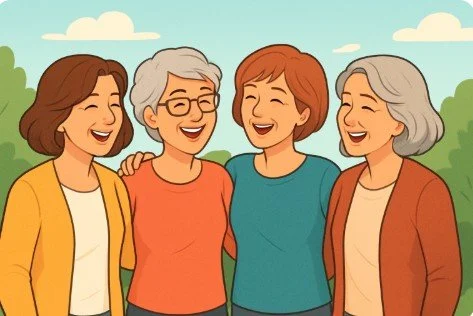
a group of older women chatting and laughing
When I was young, friendships were somewhat easy. There always seemed to be friends to hang around with, people to call on a whim, groups to join spontaneously. Looking back now, I'm not entirely sure if I really nurtured those relationships for the long haul, or if I simply enjoyed the moment. Yet somehow, some of those early connections endured. I still consider some of them friends, even though we don't hang out all the time anymore. Life has a way of reshaping our social landscapes, doesn't it?
The Evolution of Friendships Through Life's Seasons
Eventually, life happens, and friendships change in ways we never quite anticipate. We marry and suddenly find ourselves part of a couple, surrounded by other couples. We have kids, and suddenly our social circles revolve around playdates, school activities, and soccer games. Our friendships become intertwined with our children's lives—parents we chat with at drop-off, families go to competitions with, people we see at every school event.
Now that I'm in my 50s, living a couple of hours from where I spent most of my career, I've discovered that finding friends seems to be more difficult in some ways and yet easier in others. It's a paradox that catches many of us off guard during this life transition.
The Challenge of Geographic Distance and Life Changes
Living in a newer neighborhood has helped some. I've made a few friends with neighbors, though these friendships sometimes feel like they exist in a different category—friendly waves over the fence, occasional get-togethers, but perhaps not yet the deeper connections I crave. The friends I've had for a number of years now live much further away. Some have moved in opposite directions after retirement.
These long-standing friendships face a real risk. If we don't actively nurture and keep in touch, they may fade over time. The distance makes it easy to let weeks, then months, slip by without real connection. Yet these are often the people who know us best, who remember who we were before life's various transformations.
Why Friendships Matter More Than Ever After 50
Before diving into strategies for maintaining and building friendships, it's worth understanding why this matters so profoundly. Research consistently shows that social connections are fundamental to healthy aging. Strong friendships can reduce the risk of early death, while social isolation carries health risks comparable to smoking cigarettes daily.
The health benefits of friendship are remarkable and far-reaching:
Mental Health Benefits: Friendships provide a crucial buffer against depression and anxiety. People with robust social networks experience significantly lower rates of depressive symptoms and have better cognitive function as they age. In fact, strong social connections can reduce the rate of cognitive decline and dementia by up to 70 percent.
Physical Health Advantages: The benefits extend well beyond mental well-being. People with strong social ties have lower blood pressure, reduced inflammation, and a lower risk of cardiovascular disease. Those who maintain active social lives are less likely to develop heart disease and less likely to experience a stroke. Social connection even strengthens the immune system, helping people fight off illnesses and recover more quickly when they do get sick.
Longevity: Perhaps most striking, maintaining meaningful relationships may actually slow the aging process at a cellular level. Research examining DNA-level changes suggests that older adults with the most supportive relationships were aging one to two years slower than those who lacked such connections.
Strategies That Work: Intentional Connection
One friend and I have found a solution that works beautifully for us. We have a subscription to plays that brings us into the city for lunch to catch up, followed by watching a performance together. Just half a dozen days spread throughout the year ensures we maintain that vital connection. It's structured enough that we commit to it, yet flexible enough to feel natural rather than forced.
Work acquaintances from my career have been planning get-togethers, and we've managed to meet up once. It's nice to keep that connection alive, even if it requires more effort now than it did when we saw each other daily in the office. Working in a new job presents its own challenges—most of the people are at a different stage of life, making it harder to find common ground for friendship outside of work.
Practical Ways to Maintain Existing Friendships
Maintaining friendships after 50 requires intentionality. Here are evidence-based strategies that make a real difference:
Schedule Regular Contact: Rather than waiting for the perfect moment, put friendship maintenance on your calendar. Set aside specific time each week for one-on-one phone calls, video chats, or in-person meetups. Treat these appointments with the same importance you'd give any other commitment. Neighbours that we developed a closer connection with just before retirement now live half an hour from us. We don’t see each other often but we make dinner dates a few times a year to keep in touch.
Leverage Technology Thoughtfully: Email, text messages, video calls, and social media platforms can help bridge geographic distances. Even brief messages—sharing a photo, sending an article, asking about their day—maintain the thread of connection between deeper conversations. My kids and friends like to send funny memes back and forth. We keep that connections while having a little fun.
Create Traditions and Rituals: Like the play subscription mentioned earlier, establishing regular traditions gives friendships structure and something to anticipate. This could be monthly dinners, annual trips, weekly walks, or seasonal gatherings. The consistency matters more than the activity itself.
Stay Interested in Their Lives: Keep notes about important events in your friends' lives—birthdays, anniversaries, health concerns, grandchildren's milestones. Ask follow-up questions about things they've shared. This demonstrates that you're truly engaged in their journey. One of my friends recently became a grandmother. I have made it a point to ask about the baby and her kids.
Be the Initiator: Don't wait for others to reach out first. Take the lead in planning get-togethers, making phone calls, and extending invitations. Many people appreciate this initiative but struggle to take the first step themselves.
Making New Friends After Retirement
If maintaining old friendships requires effort, making new ones after 50 can feel even more daunting. Yet it's absolutely possible, and retirement actually provides a significant advantage: time. Here's how to make it work:
Join Groups Aligned With Your Interests: Whether it's art classes, book clubs, hiking groups, or volunteer organizations, participating in activities you genuinely enjoy naturally connects you with like-minded people. Shared interests provide an immediate foundation for conversation and connection.
Become a Regular Somewhere: Frequent the same coffee shop, library, fitness class, or park. Seeing familiar faces repeatedly makes it easier to move from nodding acknowledgment to actual conversation. Consistency breeds connection.
Embrace Learning Opportunities: Take classes in subjects that interest you—whether it's pottery, ballroom dancing, photography, or foreign languages. Learning environments create natural opportunities for interaction and shared experiences.
Consider Volunteer Work: Volunteering connects you with people who share your values and gives you meaningful work to discuss. It also provides regular interaction and a sense of purpose.
Explore Senior Centers and Community Programs: Many communities offer programs specifically designed for older adults, from exercise classes to cultural outings. These venues understand the challenges of making friends later in life and often structure activities to facilitate connection.
Give Relationships Time to Develop: Friendship requires repeated interaction. You can't attend one event and expect to find your best friend. Commit to showing up regularly to the same activities, giving relationships time to deepen naturally.
Reconnect With Old Friends: Social media and the internet make it easier than ever to find people you've lost touch with over the years. Old friends share history with you, providing an excellent foundation for renewed connection. Don't assume they're too busy to reconnect—they may be hoping you'll reach out.
"Promote" Work Relationships: Former colleagues can become genuine friends once professional boundaries dissolve. After retirement, those workplace acquaintances you enjoyed can transition into real friendships based on shared interests beyond work.
Overcoming Common Obstacles
Several challenges commonly arise when building friendships after 50:
Different Life Stages: If you're working in a new job where colleagues are younger, they may be juggling young children, building careers, or navigating life stages you've moved beyond. Look for connection points that transcend age—shared professional interests, hobbies, or values.
Physical Limitations: Health challenges can make socializing harder. Look for activities that accommodate your physical abilities, whether that's chair yoga, online communities, or venues with good accessibility.
Shyness or Introversion: If you're naturally reserved, making new friends feels especially challenging. Remember that introverts often build deeper, more lasting friendships because they invest more fully in fewer relationships. Start small—aim for one or two quality connections rather than a large social circle.
Loss and Grief: The death of a spouse or close friend can make socializing painful, especially when navigating social situations alone after years as part of a couple. Grief support groups can provide understanding companions who share your experience.
Feeling Awkward: It's natural to feel uncomfortable initiating conversations or inviting someone to coffee. Remember that many people feel this same hesitation and will welcome your friendliness. Asking questions about others—their interests, experiences, opinions—helps break the ice.
The Role of Living Situation
Where you live significantly impacts friendship opportunities. Active adult communities and senior living residences are specifically designed to facilitate social connection, offering built-in activities, communal spaces, and neighbors at similar life stages. However, you don't need to live in such a community to build friendships. Focus on creating opportunities within your current environment.
If you're in a newer neighborhood like mine, be patient. Neighborhood friendships often develop slowly, beginning with casual encounters and gradually deepening over time. Host a gathering, attend neighborhood events, or simply make a habit of being visible—taking walks, working in your yard, sitting on your porch.
Moving Forward: An Investment in Well-Being
Making and maintaining friendships after 50 isn't just about avoiding loneliness—though that alone would be worthwhile. It's an investment in your physical health, mental sharpness, emotional resilience, and longevity. Every conversation, every shared laugh, every listening ear contributes to your overall well-being.
Yes, it takes effort. Yes, it might feel awkward at first. Yes, you'll sometimes feel vulnerable or uncertain. But the alternative—isolation and its profound health consequences—makes the effort worthwhile.
As I navigate my own 50s, I'm learning that friendship in this season of life looks different than it did in my youth. It's more intentional, more precious, and often harder won. But it's also deeper, more authentic, and more consciously chosen. The friends I maintain and make now are people I actively choose to keep in my life, not just those who happen to be conveniently nearby.
The half-dozen days per year I spend with my friend at plays, the occasional get-togethers with former colleagues, the slowly developing connections with neighbors—each represents a thread in the social fabric that will support and sustain me through the years ahead. And that's worth every bit of effort it takes.
Canadian Resources for Further Information
Canadian Coalition for Seniors' Mental Health (CCSMH): https://ccsmh.ca/areas-of-focus/social-isolation-and-loneliness - Developed the world's first clinical guidelines on social isolation and loneliness in older adults. Provides brochures, resources, and information for older adults and caregivers.
Government of Canada - Social Isolation Toolkit: https://www.canada.ca/en/employment-social-development/corporate/seniors/forum/social-isolation-toolkit-vol1.html - Comprehensive information on understanding and addressing social isolation among Canadian seniors.
Statistics Canada - Loneliness Among Seniors: https://www.statcan.gc.ca/o1/en/plus/4881-look-loneliness-among-seniors - Data and research on loneliness patterns among Canadian seniors.
CanAge: https://www.canage.ca - National seniors' advocacy organization working to combat loneliness and improve lives of older Canadians. Offers the #LessLonely initiative.
Meetup.com: Search for local groups based on interests, with many specifically for people over 50.
American Resources for Further Information
The National Institute on Aging: https://www.nia.nih.gov/health/social-connections-and-relationships - Provides research-based information on maintaining social connections as you age.
AARP Foundation's Connect2Affect: https://connect2affect.org - Offers resources and tools to help combat social isolation.
The Silver Line (UK-based helpline): Provides friendship and support to older adults experiencing loneliness.
Meetup.com: Search for local groups based on interests, with many specifically for people over 50.
American Psychological Association: https://www.apa.org - Offers articles and research on the psychology of friendship and aging.
The journey of friendship after 50 is one of intentionality, vulnerability, and ultimately, profound reward. Whether nurturing decades-old connections or cultivating brand-new ones, each friendship we maintain or create is an act of self-care and an investment in a healthier, happier future.

My Technology Journey: Never Too Late to Learn
Using AI has become one of the most surprising parts of my tech journey. What started as simple curiosity quickly turned into a powerful tool that helps me write, brainstorm, and explore ideas in ways I never expected. AI doesn’t replace my voice—it expands it. It gives me fresh perspectives, keeps me learning, and reminds me that staying open to new technology is one more way to stay seasoned with youth.

An older person using futuristic technology
A Surprising Discovery at 50+
For years, I thought I understood technology. After all, I'd worked alongside programmers, written use cases, tested applications, and served as a subject matter expert helping train others on new systems. I felt fairly confident in my technical knowledge.
Then ChatGPT arrived, and I realized something humbling: I barely understood the surface of what technology could do.
Like many people, I'd heard the buzz about AI—the excitement, the concerns, the stories about both its promise and its risks. Some stories were troubling, like reports of AI being misused in mental health settings with serious consequences. These concerns are valid and important. But I've also discovered that when used thoughtfully and carefully, AI can be remarkably helpful in everyday life.
Opening My Eyes: Writing with AI
A few months ago, I enrolled in a university course called "Writing with AI." It transformed my understanding completely. The course introduced me to technologies I never knew existed, and I started experimenting with them immediately.
One of my first experiments was simple but eye-opening: I asked the AI to analyze my writing style. The insights it provided were astonishing—it identified patterns, strengths, and areas for improvement that I'd never noticed after decades of writing.
Growing up in the 1970s and 80s, I never imagined technology like this would exist. Back then, research meant encyclopedias and library cards. Writing assistance meant a dictionary and maybe a thesaurus. The tools we have today would have seemed like pure science fiction.
I'll admit something: at first, using AI for coursework felt like cheating. Even though the course required it, there was this nagging feeling that I wasn't doing the "real work." But as I learned more, I realized this technology isn't about taking shortcuts—it's about working smarter and extending what we can accomplish.
Practical Uses I've Discovered
As I've gotten older, I've found AI incredibly practical for everyday tasks:
Trip Planning: Instead of spending hours researching destinations, accommodations, and itineraries, AI can create detailed travel plans in minutes
Meal Planning: Getting help with weekly menus, recipes, and even grocery lists based on dietary preferences
Health Information: Quickly finding basic health information (though I always verify with healthcare professionals)
Learning New Skills: Getting explanations and tutorials on topics I'm curious about
I'm certain I've only scratched the surface. There's so much more to explore, and I'd love to hear what others have discovered.
Important Privacy Considerations
Before we discuss AI's limitations, there's something crucial you need to know about how these tools work. Many AI applications are learning software, which means they use the information you provide to improve and train themselves. Think of it like this: when you type something into an AI tool, you might be teaching it—and that information could potentially become part of what it shares with other users in the future.
This is why you should never include personal information when using AI. Don't enter your full name, address, phone number, social security number, credit card details, medical records, or any other private information about yourself or others. Once you put that information into an AI system, you've essentially released it onto the web where others might access or use it. Treat AI tools like you would a public forum—only share what you'd be comfortable with strangers knowing.
A Word of Caution: Understanding Hallucinations
Here's something critical everyone needs to know: AI can produce what experts call "hallucinations."
What are AI hallucinations? Think of them as confident mistakes. Sometimes AI generates information that sounds completely believable but is actually incorrect or made up. It's like talking to someone who seems very sure of their facts, but is actually wrong without realizing it. The AI doesn't intend to mislead you—it simply creates responses based on patterns in its training data, and sometimes those patterns lead to false information.
This is why I'm extremely careful with any information AI provides. I always ask for sources and verify important facts independently. You can never be too cautious—after all, the AI might have learned from someone else's incorrect input.
Top 10 AI Tools Worth Exploring
Based on current information and user reviews, here are ten popular AI tools and their practical applications. I've included website links so you can verify these for yourself:
1. ChatGPT (https://chat.openai.com)
What it does: An AI assistant that can have conversations, answer questions, help with writing, and assist with various tasks
Best for: General writing help, brainstorming ideas, explaining concepts, drafting emails, and learning new topics
Example use: Ask it to help you write a professional email or explain a complicated concept in simple terms
2. Claude (https://claude.ai)
What it does: An AI assistant similar to ChatGPT, known for having thoughtful, detailed conversations
Best for: Research, document analysis, writing longer content, and working through complex problems
Example use: Upload a long document and ask for a summary of the key points
3. Perplexity AI (https://www.perplexity.ai)
What it does: An AI search engine that provides answers with links to sources
Best for: Research topics where you want to see where the information comes from
Example use: Research a medical condition and get information with links to medical websites
4. Grammarly (https://www.grammarly.com)
What it does: Checks your writing for grammar, spelling, and style issues
Best for: Improving emails, documents, and any writing where you want to sound professional
Example use: Write an important email and let Grammarly catch any mistakes and suggest improvements
5. Canva (https://www.canva.com)
What it does: A design tool with AI features that help create graphics, presentations, and social media posts
Best for: Making professional-looking materials without design experience
Example use: Create a birthday invitation or a presentation for a community group
6. Notion AI (https://www.notion.so)
What it does: A workspace tool with built-in AI that helps organize notes, projects, and information
Best for: Keeping track of personal projects, notes, and to-do lists with AI assistance
Example use: Take messy notes from a meeting and have AI organize them into clear action items
7. Fireflies.ai (https://fireflies.ai)
What it does: Joins your video meetings and automatically takes notes and creates transcripts
Best for: Keeping records of important conversations without having to write everything down
Example use: Record a Zoom call with your book club and get an automatic summary of the discussion
8. Google Gemini (https://gemini.google.com)
What it does: Google's AI assistant that can answer questions, help with tasks, and work with Google services
Best for: Research, getting quick answers, and working with documents or images
Example use: Upload a photo and ask questions about what's in it, or get help understanding a complex document
9. Jasper (https://www.jasper.ai)
What it does: An AI writing assistant focused on creating marketing content and professional writing
Best for: Writing blog posts, social media content, or any longer-form writing projects
Example use: Generate ideas for blog topics or draft a newsletter for your organization
10. Zapier (https://zapier.com)
What it does: Connects different apps and automates repetitive tasks using AI
Best for: Saving time by automating tasks like saving email attachments or updating spreadsheets
Example use: Automatically save email attachments from a specific sender to a Google Drive folder
Final Thoughts
Learning about AI has been one of the most exciting journeys of my later years. It's reminded me that we're never too old to learn new skills or embrace new technology.
The key is approaching it with curiosity, caution, and a willingness to experiment. Don't be intimidated by the technology—start small, try different tools, and see what works for you.
And remember: always verify important information, especially when it comes to health, finances, or major decisions. AI is a powerful assistant, but it should complement—not replace—your own judgment and the advice of trusted professionals.
I'd love to hear from you: What AI tools have you tried? What uses have you found most helpful in your daily life? Share your experiences in the comments below!
Note: All website links were current as of November 2025. Technology changes rapidly, so always verify that these services meet your needs and privacy requirements before signing up.

Retiring Young While Raising Adults: Our Unconventional Timeline
We retired in our mid-50s with government pensions most would envy—but our kids weren't done with college yet. This isn't the traditional retirement timeline, and it's taught us that financial security doesn't automatically bring clarity about who you are when work and active parenting both wind down. Here's what navigating early retirement while raising young adults actually looks like.

How We Got Here
My husband and I met in our early thirties. Both of us had established careers—me in government, him teaching grade school. We married when I was in my mid thirties, blending families with his daughter who was seven at the time.
We wanted children together, so we were in a bit of a rush. I had my first daughter a year after we married and our second 2 years later. My husband was late 30’s and early 40’s when our kids were born. This is somewhat older than most first-time fathers in the delivery room, but not unusually so these days.
What we didn't think much about then was the math. Starting a family later meant we'd be in our mid-fifties when our youngest graduated high school which corresponded almost exactly with our early retirement dates. We’d been counting down the years until retirement, so when the time finally came, we were ready. Or at least, we thought we were.
I retired at 55. My husband retired at 58. We both have excellent government pensions and financial security most people our age would envy. When we retired, we had a child finishing high school and one in her second year of university, and my husband's daughter from his first marriage navigating her late twenties and early career.
Our story doesn't quite fit the traditional timeline but then again, whose does? We're one of those couples whose messy, wonderful life simply doesn't follow the expected sequence. This isn't a blueprint or advice, just the real experience of navigating a life stage that refuses to be categorized neatly.
The Financial Blessing We Don't Take for Granted
Two public sector pensions mean we have stable, reliable income for life. People have commented that we're lucky to have two pensions. I acknowledge we are fortunate. But here's something often overlooked: we paid for those pensions with reduced salaries for many years. Every paycheque throughout our careers had pension contributions deducted. We earned less take-home pay than private sector counterparts in exchange for future security. It was a trade-off, not a windfall.
We saved for our kids’ education during our working lives. Our kids' education is partially funded through RESPs and our ongoing support as well as any part time jobs they had.
This financial security allows us to retire early without panic. We're not choosing between our retirement and our kids' education. We can do both.
I know how rare this is. I know many women our age are still working because they must, not because they want to. I know the pension plans we benefited from are increasingly uncommon.
We didn't earn this entirely through hard work—we also benefited from timing, stable employment sectors, and luck. I won't pretend otherwise.
But here's what's interesting: even with financial security, the emotional navigation of this life stage is complex.
Identity Beyond Work and Parenting
For decades, my identity was wrapped up in two primary roles: my career and motherhood. Both consumed most of my time, energy, and mental space.
Now, with my career ended and my children increasingly independent, I've had to answer a question I'd been too busy to ask: Who am I beyond these roles?
I've always been the one with the schedule, the obligations, the important meetings. Suddenly having unstructured time felt like a gift I didn't quite know how to unwrap.
Within four months, I found myself restless. I accepted a six-month contract with a bank, then later a two-year government management role. Now, facing the end of that contract, I'm discovering that retirement isn't about stopping—it's about choosing differently. I still feel I have something valuable to contribute, but it’s a completely different mindset when you work post retirement.
What We're Learning
Retirement is not one moment: it's an evolving phase. The truth is, we didn't arrive at retirement and simply settle in. It's been a constantly shifting landscape. Our early retirement looks nothing like it will in five years when all the kids are fully independent—or at least, we hope they will be. We're learning to hold our expectations loosely and adapt as this phase unfolds.
Financial security doesn't eliminate emotional complexity. Having two pensions solved our money problems. We can pay our bills, help our kids, and live comfortably without panic. But it didn't automatically hand us purpose, identity, or fulfillment. We still had to figure out who we were beyond our careers and active parenting. Money bought us options; what we chose to do with those options required deeper work.
Flexibility is more valuable than rigid plans. We walked into retirement imagining complete freedom—spontaneous trips, lazy mornings, life on our terms. Instead, I discovered I wasn't ready to stop working entirely. Within months, I was back at it—first a contract, then another. My husband has fully embraced retirement in a way I haven't been able to yet. But here's what we've both gained: flexibility without desperation. We're there when our daughters needs help with a college decision, when our stepdaughter calls navigating a major life decision. We can say yes to what matters because our pensions mean we're not trapped by paychecks. Relationships require time and attention, and the security we built gives us the freedom to be truly present—even if my version of retirement looks nothing like the postcard.
There's no "right" timeline. Our path—late parenthood, early retirement, kids still at home—doesn't follow the traditional sequence. Friends our age have grown children and grandchildren. Some are still climbing career ladders. We're somewhere in between. This unconventional timeline is teaching us things we never would have learned on a more traditional path.
Advice We'd Give Our Younger Selves
If I could go back to our thirties, would I do anything differently? Maybe. Maybe not.
Would I have children earlier? Perhaps. But then they wouldn't be these children, the ones I can't imagine life without.
Would I plan retirement differently? I honestly don't know. We made the best decisions we could with the information we had.
What I would tell younger us: Save aggressively. The financial security makes everything else possible. Take the long view on career planning. I believe that pensions and benefits matter enormously. It doesn’t matter if you have a pension plan or self fund your retirement. Stay physically healthy. Retirement is better when you feel good. Don't compare your timeline to others - there are many ways to build a life.
Looking Forward
In a few years, our youngest will graduate college, and our oldest will complete her second degree. The house will quiet. Our days will be... well, I'm not entirely sure yet.
I thought I knew what retirement looked like when I first left my career at 55. Freedom. Time. Choice. And for a while, I had all three. Now, as my contract ends, I'm facing a questions I didn't expect: Will I retire or extend my contract? What does retirement actually mean when you still want to work?
Here's what I'm learning: maybe retirement isn't about stopping. Maybe it's about choosing differently. This may mean working when it fulfills you, saying no when it doesn't, and accepting that the path forward doesn't have to look like anyone else's version.
Right now, I'm still working. The "freedom" I imagined feels more theoretical than real. But I'm also not trapped. I have pensions that mean I can walk away whenever I'm ready. That safety net changes everything, even if I'm not using it yet.

My Family's Food Revolution
Severe psoriasis at age 9 led our family down a path of food documentaries, dietary changes, and surprising results. While I can't claim food was a miracle cure, something kept the psoriasis away. This experience sparked a lasting interest in nutrition after 50—here's what I've learned about protein, fiber, and eating well as we age.

Seasoned with Youth
When my youngest daughter was 9, she was diagnosed with psoriasis. Red marks covered her torso and hairline. It didn't seem to hurt her, but she was embarrassed, so we sought help. The dermatologist told me it was the worst case of pediatric psoriasis she had ever seen and outlined the evolving treatments my daughter would need for the rest of her life. This terrified me. The thought of increasing medications and treatments was not something I wanted for my child.
As if one health concern wasn't enough, around this same time, I was facing another worry with my oldest daughter who was a competitive dancer. A co-worker warned me that dance could affect the curvature of her spine and lead to back problems later in life.
In my pursuit of keeping both my daughters healthy for their adult years, I discovered an osteopath who changed my perspective entirely. She introduced me to the idea of supporting the body's health through diet and exercise. She recommended a documentary called "Forks Over Knives," which sent me down a rabbit hole of watching documentaries to learn about food and health. These documentaries opened my eyes to the connection between food and healing. We committed to trying a whole food, plant-based approach, not knowing what to expect.
My youngest daughter's psoriasis seemed to clear up as we eliminated certain foods. When I returned to the specialist and shared this, she became angry. She insisted it wasn't the diet that cleared it up—it was the ointments she had prescribed and the summer sun. This doctor, who had initially tried to reassure my fears about the medications, was now yelling at me, dismissing everything I had tried to help my daughter. She declared that I'd be back in a few months because "that's when she sees all her psoriasis patients." She told me to keep the SickKids appointment she had referred us to, which I did for three years. The doctors there never saw any psoriasis on my daughter's body.
Twelve years later, my daughter has never sought additional treatment for her skin condition.
I want to be clear: I'm not claiming food was a miracle cure. The improvement we saw was our family's experience, not scientific proof. Current dermatology research doesn't confirm a direct causal relationship between diet and psoriasis, though it acknowledges that certain foods can help reduce inflammation. But something kept the psoriasis away. For a few years, we really tried to have her eat properly, though it was challenging—she has a mega sweet tooth, and she ate terribly in high school.
We never became fully plant-based, but for many years we focused on eating healthy. It's not always easy but I believe that if you eat well most of the time, you'll stay healthy. We also need to enjoy a few treats; a few indulgences here and there aren't going to hurt you and sometimes is needed to get you through the day.
Everyone seems to have their own ideas about what the body needs to stay healthy as you age. While I'm not a health professional, my daughter's experience sparked a lasting interest in nutrition and aging well. Here's what I've learned from reading about healthy eating after 50:
Key Nutritional Recommendations After 50:
1. Protein becomes more important than ever. Muscle loss accelerates around age 50, and protein intake needs to increase to help maintain what's there. The exact amount varies depending on activity level, body size, and individual health factors—it's worth doing some personal research to figure out what works best.
2. Certain nutrients deserve extra attention. Potassium, calcium, vitamin D, fiber, and vitamin B12 all become increasingly important after 50. The body's ability to absorb B12 can decline with age, sometimes due to underlying health conditions. Calcium needs also increase for women after 50—it's not just about bone health, but also supports heart function, nerves, and muscles.
3. Fiber matters more than most people realize. Most people don't get nearly enough fiber, even though it plays a major role in digestive health and can help reduce the risk of developing type 2 diabetes. It's one of those unsexy nutritional facts that actually makes a real difference.
4. Color on the plate is a good sign. The natural blues, yellows, and reds in fruits and vegetables usually signal heart-protecting antioxidants. Dark leafy greens like kale, arugula, broccoli, and spinach pack in fiber, support muscle function, and promote heart health. Basically, the more colorful the plate, the better.
5. Watch the usual suspects: sugar, saturated fat, and sodium Limiting added sugars, saturated fats, and sodium helps reduce the risk of high blood pressure, diabetes, and heart disease. It's not about perfection, but being mindful of these makes a difference over time. After 50, we know what works for our bodies.
What is one simple, non-negotiable healthy food or habit you swear by for energy and feeling great?