
Navigating Menopause: When Your Body Writes Its Own Script
Menopause: The Unscripted Adventure No One Warned You About
Menopause doesn’t come with a manual — or a warning. Some of us sail through like our grandmothers, lucky ducks, while others get blindsided by symptoms no one even whispered about. Night sweats that turn your bed into a water park, random periods that pop up like surprise guests, or skin so itchy it’s auditioning for a horror movie — it’s all part of the hormonal rollercoaster.
And let’s be honest: the mirror doesn’t lie, but it also doesn’t tell the full story. Inside, you feel like your 35-year-old self, but outside? Your body is clearly writing its own dramatic narrative. The good news? Understanding what’s happening, arming yourself with a few survival strategies, and knowing when to call in the pros can make this journey a lot less chaotic — maybe even occasionally funny.
Whether your experience is mild, extreme, brief, or marathon-long, it matters. And no matter what anyone says, you are never too young, too old, or too tired to advocate for your health — and yes, that includes demanding support, sanity-saving advice, and maybe even a little extra wine.
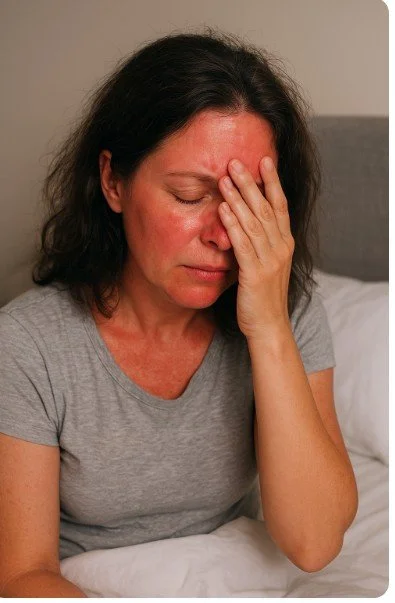
woman having a hot flash at night AI generated
We get all sorts of lovely hand-me-downs from the women before us — grandma’s recipes, mom’s mannerisms, maybe even an unfortunate family name or two. But menopause? Oh no. That’s where our bodies suddenly decide to go “Thanks for the lineage, ladies, but I’m gonna freestyle this one.”
Because of course the one thing we want to predict is the one thing that shows up like, “Surprise! I do what I want.”
The Myth of the "Typical" Experience
My grandmother's life was a testament to resilience. Born in the early 1900s, she became a single mother in her 20s—no small feat for a woman of her generation. She married my grandfather in her 30s and had three more children with him. Her final pregnancy, when she was carrying what would have been a boy, ended in heartbreak. The baby was born around seven months and didn't survive.
What happened next shaped her experience of menopause in an unexpected way. As she told me years later, she simply never got her monthly again after that final pregnancy. Just like that, in her late 30s, her body made a decision. No gradual tapering, no years of irregular cycles, no hot flashes she ever mentioned. Her periods stopped, and she moved forward with the same quiet strength she'd shown through everything else.
Hearing her story, I was convinced I'd inherited this trait. Surely I'd be like my grandmother—sailing through menopause in my early 40s without fanfare. Reality had other plans.
For years in my 40s, I knew something was shifting. My previously reliable cycle became unpredictable, yet when I asked doctors to check my hormone levels, I was repeatedly told I was "too young." By my late 40s, my body went haywire—periods every few weeks, then months of nothing. Night sweats appeared suddenly at 50, then vanished just as mysteriously. Fourteen months after what I thought was my last period, I had one more small reminder. That was nine years ago.
Don't get me wrong—I did not sail through menopause like my grandmother appeared to. Though honestly, I'm not sure she really did. There's just something you don't share with someone in their late teens or early 20s when you're in your 70s. And honestly, she might’ve had her own menopausal saga — she just never said a word. Women back then kept quiet about everything, like it was some sort of Olympic event in silent suffering.
As for me? Oh, I’ve had the whole sampler platter of symptoms. Sleepless nights? Check. Skin so itchy I’m shocked I haven’t clawed myself like a cat with an attitude problem? Double check. My hair’s drier, my skin has its own storyline, and don’t even get me started on my reflection. I look in the mirror and think, “Who is that?” because in my mind, I am — and forever shall be — 35.
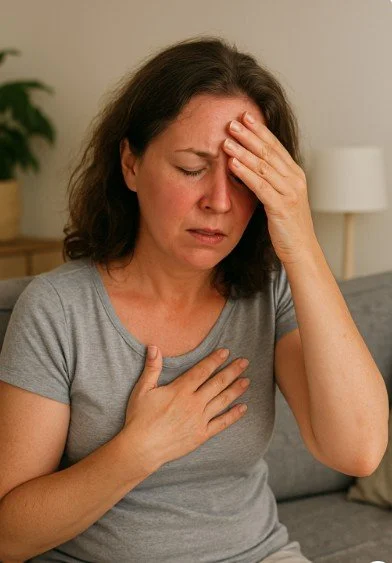
women with menopause symptoms AI generated
Common Menopause Symptoms
I am not a physician or medical professional. The information shared here is based on what I have found through various sources and personal research. It is intended for general information only and should not be considered medical advice. Please consult a physician or another trusted healthcare professional regarding your own health concerns or questions.
While every woman's experience is unique, certain symptoms appear frequently during perimenopause and menopause and seem to be a natural response to aging:
Irregular periods - Often the first sign, cycles may become shorter, longer, heavier, lighter, or wildly unpredictable before stopping altogether.
In perimenopause, hormone levels (especially estrogen and progesterone) fluctuate, so cycles often become shorter, longer, heavier, lighter, or skipped before stopping for 12 consecutive months.
This irregularity can last several years and is usually normal, but very heavy bleeding, bleeding after sex, or bleeding after 12 months without a period should be evaluated by a clinician.
I did have one random, surprise period after 14 months — because of course my body couldn’t just let me celebrate in peace. At the time, I didn’t go running to the doctor, though I absolutely would have if it happened again or came with any other weird side quests. Honestly? I didn’t even realize it was something I should be mildly alarmed about. I’d heard so many mixed messages about menopause that I just chalked it up to “yet another bizarre thing my body is doing for reasons unknown.”
Vasomotor symptoms (Hot flashes and night sweats) - Sudden waves of heat that can disrupt sleep and daily life are among the most common menopause complaints; large reviews estimate that roughly half or more of midlife women experience them globally, with some regional variation.. They may last months or years, or barely appear at all.
These episodes can disrupt sleep, concentration, and work performance; some women have only mild occasional flashes, while others have frequent, intense symptoms for many years.
I went through a few solid months of night sweats — the kind where you wake up feeling like you’ve been sleeping in a slow cooker — but luckily I dodged most of the classic hot flashes. Silver linings, right?
But my body has definitely become extra dramatic about temperature. Too hot, too cold… apparently I’m Goldilocks now. I remember getting the same “thermostat gone rogue” vibes when I was pregnant, so I’m guessing it’s hormone-related — though I have zero medical proof and my degree in Googling symptoms is not exactly accredited.
If anyone else has dealt with this little temperature circus, I’d honestly love to hear your take.
Sleep disturbances - Whether from night sweats or hormonal changes, insomnia becomes an unwelcome companion for many women.
Difficulty falling asleep, frequent night waking, and non‑restorative sleep affect about half of midlife women and is often linked to both night sweats and direct hormonal effects on sleep regulation.
Poor sleep then feeds into daytime fatigue, mood changes, and “brain fog,” creating a cycle that can significantly impair quality of life.
I’m still battling those lovely sleepless nights — because apparently my brain thinks 3 a.m. is the perfect time to relive every embarrassing moment from 1994. My go-to fixes? I’m not saying they’re doctor-approved, but I sometimes slap magnesium oil on the bottoms of my feet or pop a melatonin. Most of the time, they do the trick.
Although… now I’m side-eyeing melatonin after stumbling across an article hinting at a possible link to heart disease. Fabulous. Just what we needed — another thing to overthink at bedtime. I’ll dig into the actual research before tossing the bottle into the trash, though.
And listen, I used to unwind with a glass of wine after work. It was my tiny nightly reward for surviving adulthood. But after reading a few too-many “concerning articles,” I’ve dialed it back. Not gone forever — just not an every-evening habit anymore. Yet again, something else added to my “must research when I have the energy” list.
When all else fails? I just get up and read for a bit. Honestly, I’ve learned that a couple bad nights don’t mean I’m doomed — usually, a good solid sleep eventually swoops in like a hero sliding into the last 15 minutes of an action movie..
Skin changes - Dryness, itching, and changes in texture and elasticity. Estrogen helps maintain collagen, skin thickness, and moisture, so declining levels contribute to drier, thinner, less elastic skin and can make wrinkles and sagging more noticeable. You might look in the mirror and not quite recognize the face looking back, even though you still feel 35 in your head.
I moisturize every single day — it’s basically my long-standing religion at this point, thanks to my naturally dry skin. Sadly, the itchiness did not get the memo and continues to do its own thing. So far, nothing I’ve tried has made much of a difference, and I’m running out of lotions that don’t claim to be “life-changing.”
If anyone out there has cracked the code on this itchy nonsense, I would love to hear your wisdom. Honestly, at this point I’ll take tips, tricks, old wives’ tales — whatever you’ve got.
Hair changes - Thinning, dryness, and changes in texture are common as estrogen levels decline.
Many women also report hair thinning, dryness, or changes in texture around menopause, related to hormonal shifts and, in some cases, genetic pattern hair loss becoming more visible.
I’ve always had thick hair — the kind that makes you feel like you’re carrying a small animal on your head. But lately, the texture has thrown me for a loop. Sure, it’s always been a bit on the dry side, but now it’s practically auditioning for a role in Desert Hair: The Musical. My scalp has joined the rebellion too, sprouting dry patches like it’s going out of style.
I tried a shampoo and conditioner made for dry scalps, which helped… a little. But now some of the dryness is creeping back, so I might have to play product roulette again. Winter seems to be the main culprit — apparently my hair and scalp are seasonal divas.
Mood shifts - Irritability, anxiety, and low mood can accompany hormonal fluctuations.
Irritability, anxiety, low mood, and emotional lability are frequently reported during the transition, and studies show that pre‑existing mood or anxiety disorders can temporarily worsen at this time. Cognitive symptoms such as forgetfulness, trouble finding words, and difficulty concentrating are commonly described; research suggests they are real but usually mild to moderate and often improve over time rather than progressing like dementia
Brain fog - Difficulty concentrating and memory lapses that can be frustrating and unsettling.
I can totally relate to losing words and forgetting things. My once-sharp memory has definitely taken a bit of a vacation. It’s especially embarrassing when I’m in the middle of a presentation and suddenly my brain swaps out the exact word I need for some very basic, everyday substitute. You know — when the fancy word disappears and all you’re left with is “that thing… you know… the thing.”
I was starting to get a little concerned about it, to be honest. Then, during a casual chat with a neighbour who’s around my age, we somehow landed on the topic of memory and our shared worries. She told me about a book she was reading — written by a neuroscientist — and explained that what we were experiencing was actually quite normal.
I bought the book immediately (because of course I did). And honestly? It made me feel so much better. Knowing that this kind of memory slip is a natural part of aging was incredibly reassuring. Now if only it could help a little more with word retrieval… because standing there mid-sentence, hoping the right word magically shows up, is still a daily adventure. 😅
Vaginal dryness - Decreased lubrication and tissue changes that can affect comfort and intimacy. Loss of estrogen leads to thinning and drying of the vaginal and vulvar tissues and can reduce natural lubrication, causing discomfort, burning, or pain with intercourse (part of what is now called genitourinary syndrome of menopause).
These changes, along with possible reductions in libido and sleep/mood problems, can affect intimacy, but local vaginal estrogen, non‑hormonal moisturizers and lubricants, and open communication often help significantly.
Okay… vaginal dryness.
There, I said it. Honestly, this topic feels a little personal — like the kind of thing you whisper to your best friend over a glass of wine while pretending the waiter can’t hear you. But here we are.
I did notice some… let’s call them “changes” in my pelvic floor, and like many of us, I tried to fix it myself with Kegels. Because of course isn’t that the magic answer to everything from childbirth recovery to solving world peace?
Apparently not.
Things started getting worse, so I finally went to a pelvic floor specialist. And you know what she told me?
“Stop doing Kegels.”
Excuse me?
Turns out the muscles around my bladder were too tight, and all those Kegels were basically making me the overachiever no one asked for. She actually had me start doing reverse Kegels, which I didn’t even know existed. Reverse! Who knew there was a backwards version of something I barely understood forward?
She also suggested I talk to my doctor, who prescribed HRT suppositories. They definitely helped — though I can’t say everything is fully cured.
Let’s just say… it’s better. Mostly. On good days.
And on other days?
Well…
Let’s just say the word “Depends” suddenly feels like both a joke and a lifestyle choice. 😉
Alright, let’s dive into the glamorous world of… menopause.
I know, I know — not exactly the spa day we ordered.
So here we are, talking about something we’d honestly prefer to pretend isn’t happening. People keep telling us, “Oh, women have gone through this since the dawn of time!” Sure, but also… did they? Life expectancy back then was much shorter, and most women spent their “golden years” churning butter or dodging plagues. If they hit 50, I’m pretty sure they were too busy being alive to complain about hot flashes.
On the other hand, we get the extended edition of this whole hormonal circus — lucky us!
But hey, if we’re living longer, we might as well live comfortably, right?
What You Can Do On Your Own
(aka: Ways to Survive the Daily Surprise Parties Your Body Throws Without Warning)
While medical intervention is sometimes necessary, many women find relief through self-care strategies:
For hot flashes and night sweats
Aka “internal spontaneous combustion.”
• Dress in layers you can dramatically rip off mid-conversation
• Keep your bedroom cold enough to store meat
• Watch out for spicy foods, caffeine, and alcohol — basically all the fun things
• Own a tiny fan you can whip out like a Victorian lady having a moment
For skin itching and dryness
Because apparently we’re turning into lizards now.
• Use gentle, fragrance-free moisturizers right after bathing
• Cooler, shorter showers (sorry… long steamy showers, it’s not you, it’s menopause)
• Add a humidifier to your home — bonus, plants love it
• Colloidal oatmeal baths if you’re feeling itchy and fancy
• Hydrate like it’s your full-time job
For sleep problems
Insomnia: the gift that keeps on giving.
• Keep a consistent bedtime routine (yes, like a toddler)
• Kick electronics out of your bedroom — doomscrolling and sleep do not mix
• Try deep breathing or progressive muscle relaxation
• Avoid caffeine after noon unless you want to stare at your ceiling all night
For hair and scalp dryness
Because why shouldn’t our hair join the rebellion?
• Switch to sulfate-free shampoos
• Ease up on heat styling (your hair will thank you)
• Deep-condition like you’re auditioning for a shampoo commercial
• Silk or satin pillowcases — luxurious and practical
For overall wellbeing
Aka keeping your sanity intact.
• Move your body — exercise helps mood, sleep, and bones (basically everything except folding laundry)
• Eat balanced meals rich in calcium and vitamin D
• Stay connected with your people — girl chats are medicinal
• Try yoga, meditation, journaling, or whatever helps you feel grounded
• Join menopause support groups — because nothing bonds women like sharing hot-flash horror stories
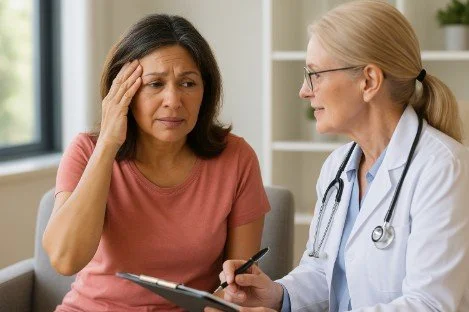
woman getting help with menopause symptoms. AI generated
When to Seek Medical Help
Sure, we like to think we’re total badasses — and honestly, we are — but even warriors sometimes need a little reinforcement.
(And no, “reinforcement” does not just mean pouring another glass of wine… tempting as that may be.)
Reach out to your doctor if:
• Your symptoms are steamrolling your quality of life
• You’re dealing with heavy or prolonged bleeding
• You have bleeding after 12 months without a period
• Your mood has dipped into depression or severe anxiety territory
• Home remedies have failed, the wine is no longer cutting it, and you’re one hot flash away from flinging your poor fan across the room in a dramatic meltdown
The Bottom Line
Menopause? Yeah, it doesn’t come with instructions, a script, or even a polite warning. You might glide through it like your grandmother did — lucky her — or you might get hit with symptoms she never once mentioned, probably because she was too busy keeping a stiff upper lip and pretending everything was fine. You might be waiting for the dramatic, headline-worthy changes everyone warned you about, while quietly suffering through the sneakier stuff — night sweats that turn your bed into a water park, relentless itching, or those glorious nights spent starring at the ceiling like it owes you an explanation.
And let’s talk about that mirror disconnect. Your body is out here doing its own thing, telling a story you didn’t sign up for, on a timeline that’s clearly off-script. Meanwhile, your brain is like, “Wait, wasn’t I supposed to still look 35?”
Here’s the thing: understanding what’s happening, having a few tricks in your back pocket, and knowing when to call in the pros can turn this hormonal rollercoaster from total chaos into… well, something a little more survivable.
Your experience is valid — whether it’s a minor blip, a full-blown circus, a one-night wonder, or a multi-month saga. And no matter what anyone might tell you, you are never too young, too old, or too “whatever” to advocate for your health and demand the support (and sanity-saving advice) you deserve.